Mostrando las entradas con la etiqueta Sun. Mostrar todas las entradas

lunes, 24 de marzo de 2008

Looking for sun?

While a lot are still buried in snow there are some who watch the sun. It is supposedly a boring time to watch the sun since it's the low point in the 11 year activity cycle of the sun. But there was something to watch with Easter. When Katrina hit in 2005 the sun was supposed to be quiet as well. Coincidence? In August '06 when i read back space.com reported the start of the new cycle. That would make it '11 - '12 for the peak of activity. Hmm, 2012... wasn't that when the Ancient Mayan calender ended? Theories, theories...

Anyway here is an animation of last weekends activity from spaceweather.com:


viernes, 28 de septiembre de 2007

Sunrise

Another sunrise in Second Life. If it were only for the color it's worth posting.

miércoles, 19 de septiembre de 2007

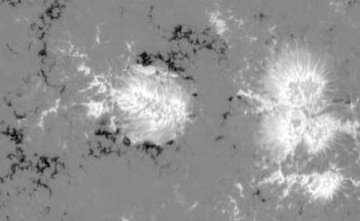
Hinode Views 'Magnetic Trilobite' Sunspot

Hinode image of sunspot 10926 "We've never seen anything quite like it," says solar physicist Lika Guhathakurta from NASA headquarters.

Movie (Quicktime, 19 MB)

Guhathakurta sat in an audience of nearly two hundred colleagues at the Living with a Star Workshop in Boulder, Colorado, and watched in amazement as Saku Tsuneta of Japan played a movie of sunspot 10926 breaking through the turbulent surface of the sun. Before their very eyes an object as big as a planet materialized, and no one was prepared for the form it took.

"It looks like a prehistoric trilobite," said Marc De Rosa, a scientist from Lockheed Martin's Solar and Astrophysics Laboratory in Palo Alto, Calif. "To me it seemed more like cellular mitosis in which duplicated chromosomes self-assemble into two daughter cells," countered Guhathakurta.

Image above, right: A magnetic map of emerging sunspot 10926 recorded by Hinode in Dec. 2006. From beginning to end, the time-lapse movie spans 6 days. The "trilobite" centered above is about the size of Earth. + QuickTime movie (5 MB) Credit: Hinode JAXA/NASA

"This movie is a magnetogram -- a dynamic map tracing the sunspot's intense magnetism," Guhathakurta explains. "Black represents negative (S) polarity, and white represents positive (N)."

The data were gathered by the Japanese Space Agency's Hinode spacecraft, launched in Sept. 2006 as "Solar-B" on a mission to study sunspots and solar storms. "This is the highest resolution magnetogram ever taken from space," says Tsuneta, Hinode's chief scientist at the National Astronomical Observatory of Japan in Tokyo. "It's showing us things we've never seen before."

Magnetograms are the best way to study sunspots. Why? Although sunspots appear solid and sturdy, they are not made of matter. Sunspots are planet-sized knots of magnetism created by the sun's inner dynamo. Born in the depths, they bob to the solar surface where they can shift, merge, split and even appear to "swim."

"Sometimes the shifting and merging gets out of hand," says Guhathakurta. "Magnetic fields become unstable and explode, producing a powerful solar flare." The effects are manifold: flares can disrupt communications on Earth, disable satellites, threaten astronauts with deadly radiation storms and (on the bright side) trigger lovely aurora borealis--the Northern Lights. Although researchers have been studying flares for more than a century, they still cannot issue accurate flare forecasts--something astronauts in orbit or en route to the Moon would dearly love to have. Improving this situation is a key goal of the Hinode mission.

Participants at the Living With A Star Workshop were amazed by the quality of Hinode's data. "The sensitivity of Hinode's Solar Optical Telescope is much higher than anything we've ever launched before. This allows Hinode to detect even the very faintest magnetic fields." By watching the ebb and flow of magnetism and the surprising forms that emerge, "we hope to understand the behavior of sunspots and predict their eruptions."

But first they've got to deal with the trilobites. "We have a lot of work to do," says Guhathakurta. "But what a wonderful problem."

martes, 11 de septiembre de 2007

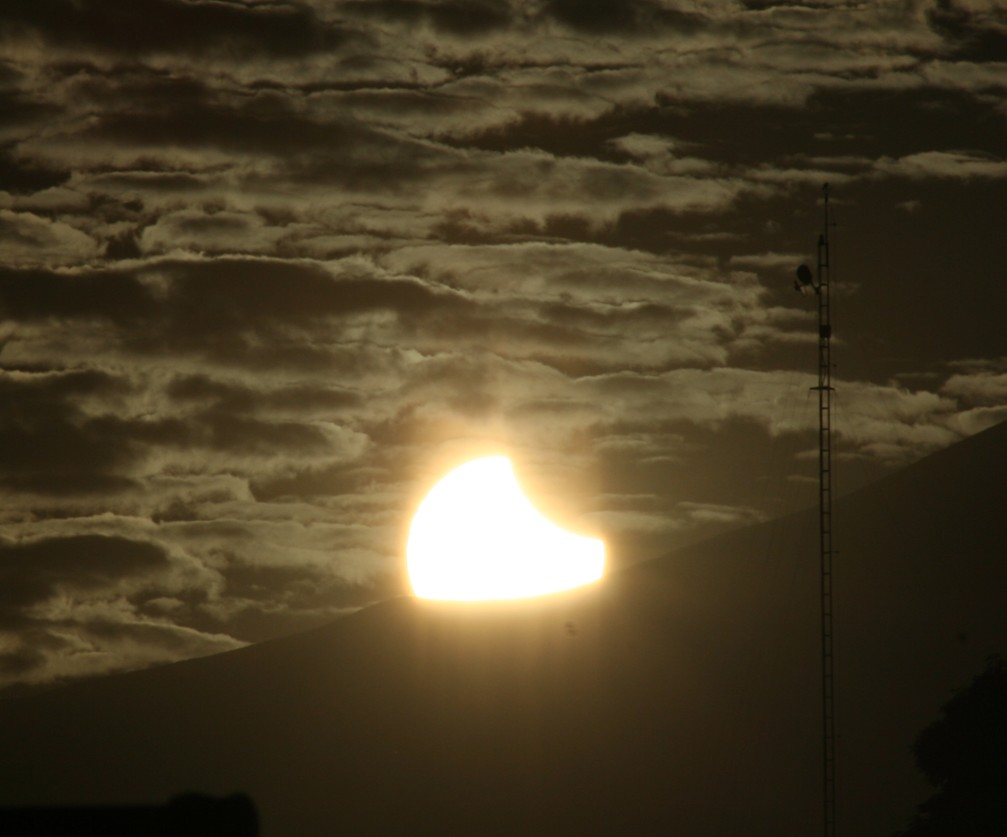
Partial eclipse of the sun

Southern South America had a partial eclipse today. 75% between Tierra del Fuego and Antarctica. This image was taken in Peru.

jueves, 30 de agosto de 2007

Mysterious Solar Ripples Detected

For the first time, scientists have observed elusive oscillations in the Sun's corona, or atmosphere. The Alfvén waves, as the ripples are known, were tracked around the entire edge of the Sun traveling along the sun's magnetic field lines. Credit: Steve Tomczyk and Scott McIntosh/NCAR

Mysterious waves that help transport the sun's energy out into space have been detected by scientists for the first time.

Researchers hope their discovery of the energetic ripples, known as Alfven waves, will shed light on other solar phenomena such as the sun's magnetic fields and its super-hot corona, or outermost atmosphere. A new video shows the ripples in action.

"Alfven waves can provide us with a window into processes that are fundamental to the workings of the sun and its impacts on Earth," said Steve Tomczyk, a space scientist with the National Center for Atmospheric Research (NCAR).

Like a wave traveling along a string, Alfven waves run along the sun's magnetic field lines and reach deep into space. While astrophysicists have identified the waves far away from the sun, they've never been detected close to our star-the ripples were too small and too fast to spot.

To observe the elusive waves, Tomczyk and his colleagues pointed the coronal multichannel polarimeter (CoMP) instrument, located at the National Solar Observatory's Sacramento Peak Observatory in New Mexico, at the sun's hot, hazy corona. Thanks to CoMP's imaging speed of one picture every 15 seconds, the scientists captured the waves traveling at about 9 million mph (14.5 million kilometers per hour).

"The waves are visible all the time and they occur all over the corona, which was initially surprising to us," said Scott McIntosh, a space scientist at the Southwest Research Institute in Boulder, Colo.

The waves might help explain how energy is transferred to the sun's corona, which is millions of degrees hotter than the solar surface.

Tomczyk and his colleagues' findings will be detailed in the Aug. 30 online edition of the journal Science.

SEE THE VIDEO: Solar Ripples

sábado, 25 de agosto de 2007

Solar eruption

Although the sun is near the lowest ebb of its 11-year activity cycle, spectacular eruptions are still possible. NASA's Stereo-A spacecraft recorded one just last week on August 18th. This is a solar prominence, a cloud of hydrogen held above the surface of the sun by magnetic force fields. Stereo A photographed the prominence just as the magnetic fields became unstable, producing a twisting, spouting eruption large enough to swallow Earth many times over.


Bigger version of this movie here.

lunes, 20 de agosto de 2007

After 4.5 Billion Years, Sunshine Finally Figured Out

A giant underground experiment has given researchers their first glimpse into the heart of the sun and the subatomic particles that shine down on Earth everyday.

Scientists have long theorized how these particles, called neutrinos, are formed in the solar inferno, but direct proof has been hard to come by. Neutrinos can give scientists a priceless glimpse into the inner workings of the sun because they arrive on Earth virtually unchanged from when they left the sun's interior.

Princeton researchers, working at the underground Gran Sasso National Laboratory in Italy, have made the first real-time observations of low-energy solar neutrinos, fundamental particles that are created by the roiling nuclear reactions inside the sun and that stream in vast numbers from the sun's core.

In stars about the size of the sun, most solar energy is produced by a complex chain of nuclear reactions that convert hydrogen into helium. These reactions can take several different routes, but they all end in the same product: sunshine.

Steps along two of the routes require the presence of the element beryllium, and physicists have theorized that these steps are responsible for creating about 10 percent of the sun's neutrinos.

Until now, technological limitations have made it hard to detect neutrinos because they rarely interact with other forms of matter.

The Gran Sasso lab's huge Borexino detector, located more than 0.62 miles (1 kilometer) underground, overcame the limitations and observed the low-energy neutrinos. The results confirmed the two nuclear steps that involve beryllium, showing that physicists have been on target at least about those routes to neutrinos.

However, that confirmation makes scientists more certain that they are also correct about how the other processes that create sunlight work, said Princeton physicist Frank Calaprice, principal investigator of the team.

"Our observations essentially confirm that we understand how the sun shines," Calaprice said. "Physicists have had theories regarding the nuclear reactions within the sun for years, but direct observations have remained elusive. Now we understand these reactions much better."

Video: Sun Storms

lunes, 6 de agosto de 2007

Solar nephelococcygia

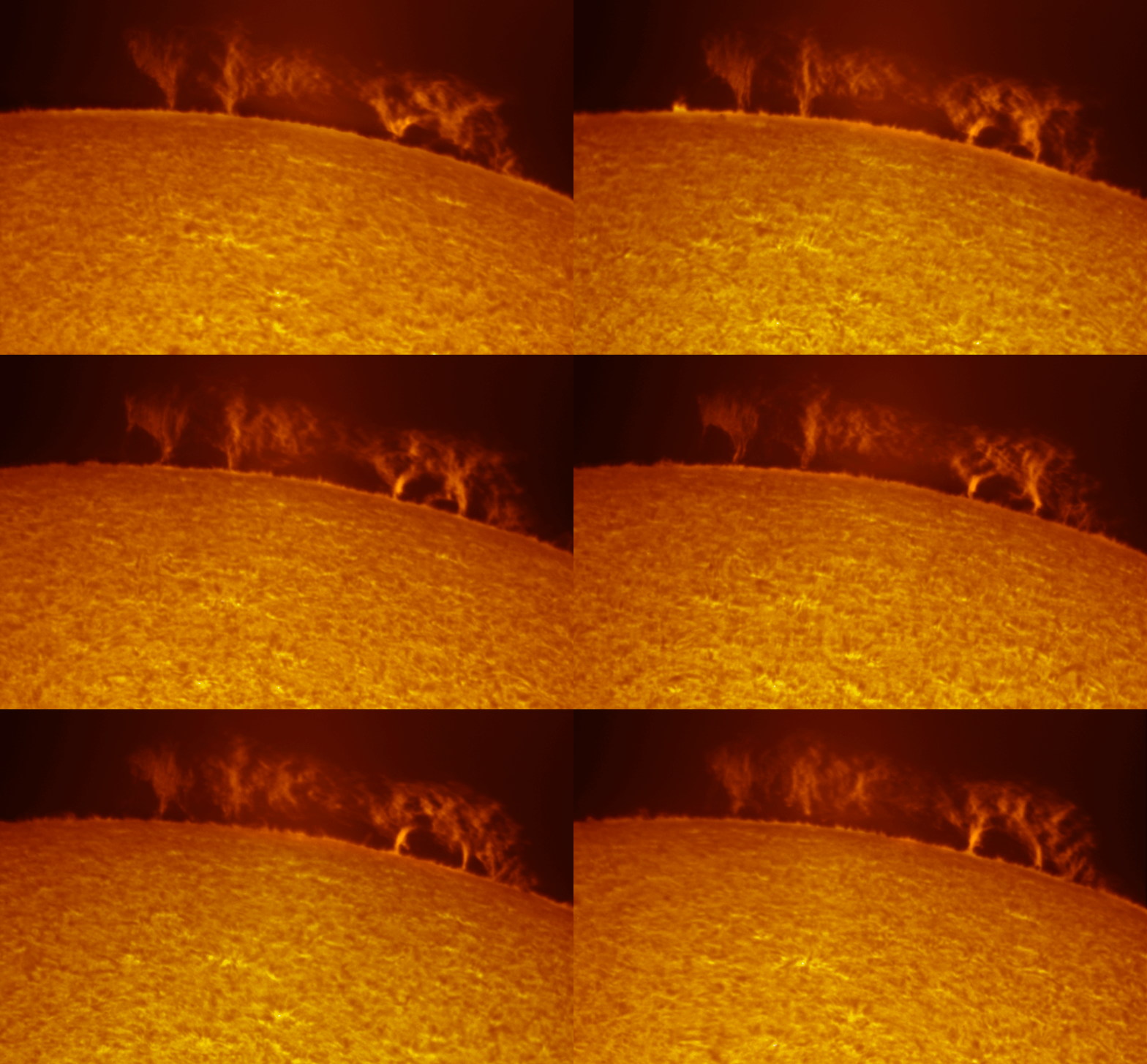
Nephelococcygia?? Ever looked at clouds and tried to see what the shape of the cloud looked like? That's nephelococcygia. The following guy looked through his solar telescope and saw this in the solar prominences. He recognized an eating dinosaur. Can you see it?

martes, 31 de julio de 2007

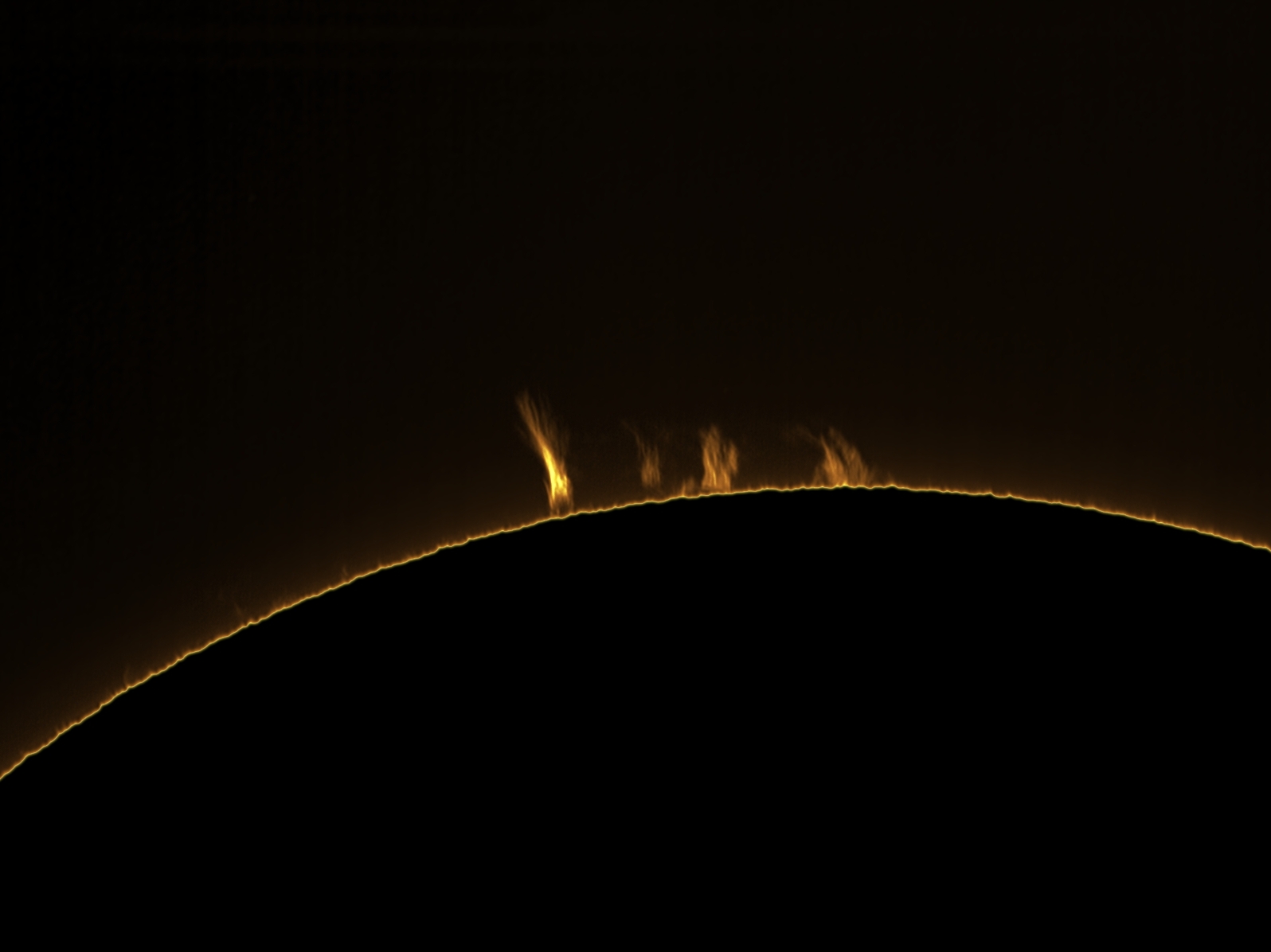
Solar prominence

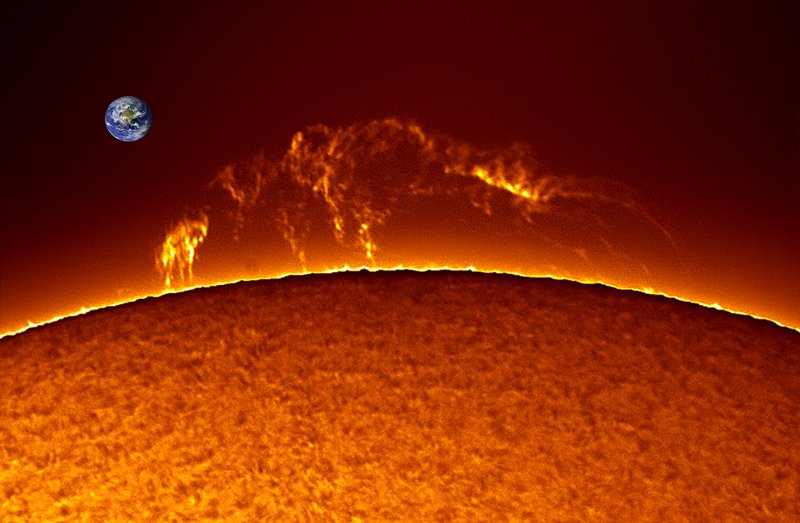
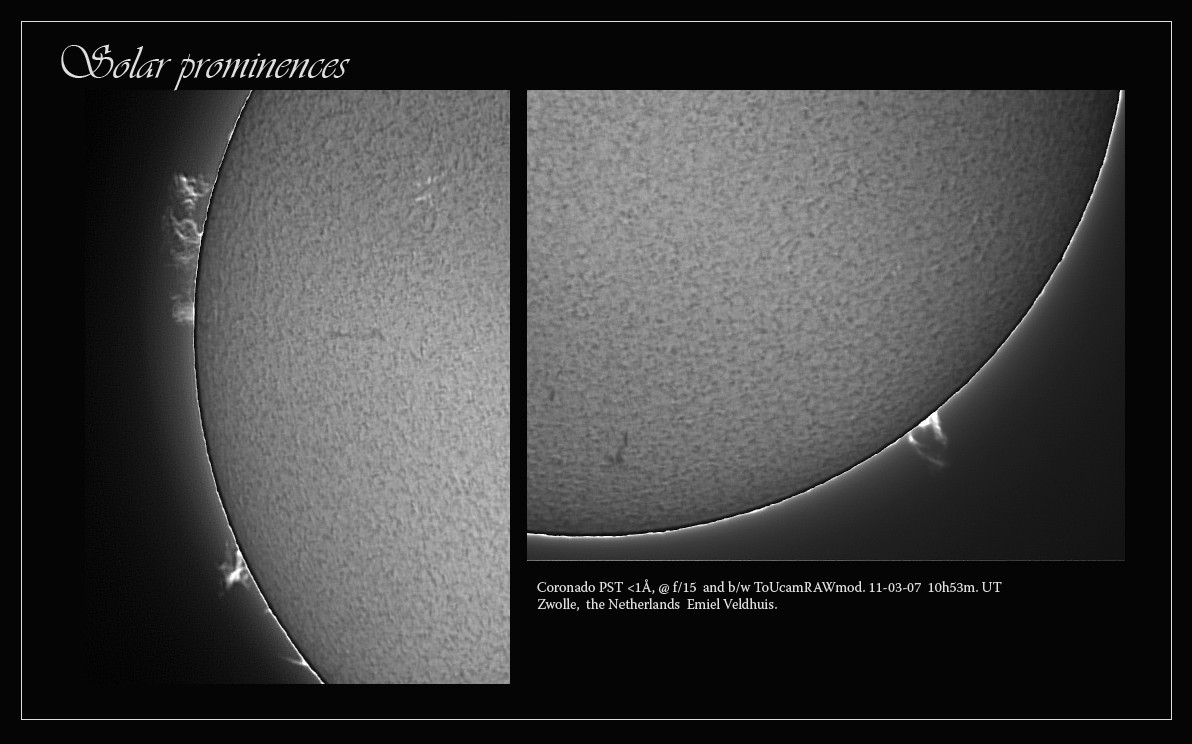
If you blow up the picture you may think it's a bush fire over the hilltop and a nice flame to light your cigar with, but it's actually a bit different. You are looking at an image from the sun through a solar telescope and the flames on the edge are called prominences. Prominences are enormous clouds of hydrogen (which make up the bulk of the sun basically) held together by solar magnetic fields.

WARNING! DON'T TRY TO SEE THIS FOR YOURSELF BY LOOKING DIRECTLY INTO THE SUN, WITH OR WITHOUT TELESCOPE OR BINOCULARS! IF YOU DO YOU WILL GET BLIND!!

viernes, 20 de julio de 2007

The sun in motion close-up

These things always make nice posts. If it were only for the color!

The dancing arcs of plasma are prominences--arcs of hot gas held aloft by barely-stable solar magnetic fields. Each ragged loop is wide enough to fit a planet; Earth could roll through one with tens of thousands of kilometers to spare.


See the large version here (6.6 MB)

lunes, 7 de mayo de 2007

Sun's Ripples Reveal Clues to the Core

The core of the Sun holds secrets into how it and the planets formed billions of years ago, but the bright solar surface obscures the view of its heart.

Now after a 30-year search, astrophysicists may have detected hints of ripples on the surface, just a few yards high, that could finally help shed light on the mysterious core.

The results suggest the Sun's core rotates more slowly than theorists have predicted.

Long search

Astronomers first detected waves on the solar surface 30 years ago. Soaring miles high, those "p-mode" waves are generated by sound running through the star. They hinted at the existence of far more subtle ripples driven by gravity. These "g-mode" waves are believed to occur when gas churning below the surface plunges even deeper and collides with denser material, sending ripples propagating through the interior and up to the surface--the equivalent of dropping a stone in a pond.

Scientists wanted to detect g-mode waves since they pass through the Sun's mysterious heart and carry vital information concerning internal activity. For instance, the speed at which the solar core rotates is uncertain. Knowing this detail could shed light on the birth of the entire solar system, because it represents the hub of rotation for the dusty cloud of matter that eventually formed the sun and planets.

Unfortunately, g-modes are badly degraded during their passage to the solar surface, and by the time they reach the exterior, they are little more than ripples a few yards high.

To make matters harder, the g-modes take between two and seven hours to rise and fall just once, which means astronomers are faced with having to detect a swell that moves just a few millimeters per second at most.

Finally, success

Now, however, an international team of astronomers employing the ESA-NASA Solar and Heliospheric Observatory (SOHO) may have finally caught glimpses of these long-sought waves, findings detailed online May 3 in the journal Science.

The key was the telescope's Global Oscillation at Low Frequency (GOLF) instrument. This device looks for bright, distinctive signals given off by sodium vapor, allowing researchers to measure ripples on the Sun with great sensitivity. The g-modes are very distinct from the p-modes in terms of both size and the speed at which they rise and fall.

The instrument cannot distinguish lone g-modes. Instead, astrophysicist Rafael Garcia at DSM/DAPNIA/Service d'Astrophysique in France and his colleagues looked for the signature of a large number of these oscillations from 10 years of GOLF data.

"By analogy, imagine that the Sun was an enormous piano playing all the notes simultaneously. Instead of looking for a particular note--middle C, for instance--it would be easier to search for all the C's, from all the octaves together," Garcia said. "So that's what we looked for, the cumulative effect of several g-modes."

What was learned

The way the g-modes got distorted as they passed through the Sun have given the first hints of the core's rotation speed. The surface of the Sun rotates at different rates depending on location, with the equator spinning faster (about 25 days) than the poles (roughly 36 days).

"The core of the Sun seems to rotate about three to five times faster on average," Garcia told LiveScience.

Current theories of solar formation suggest the original cloud of matter that gave rise to the solar system had a high rate of rotation, a remnant of which "could exist in the deepest regions of the Sun," Garcia said. "It seems that the solar core rotation is slower than expected by those theories," he added.

Garcia noted a magnetic field leftover from the solar system's formation could have contributed to slowing down the solar core. A new generation of instruments now being built that can measure individual g-modes--for instance, "the GOLF New-Generation prototype that could fly in the DynaMICCS spacecraft presented inside the Cosmic-Vision 2015-2025 ESA program"--could help provide the insight needed to explain the mysteries of the solar core, he said.

Source

jueves, 26 de abril de 2007

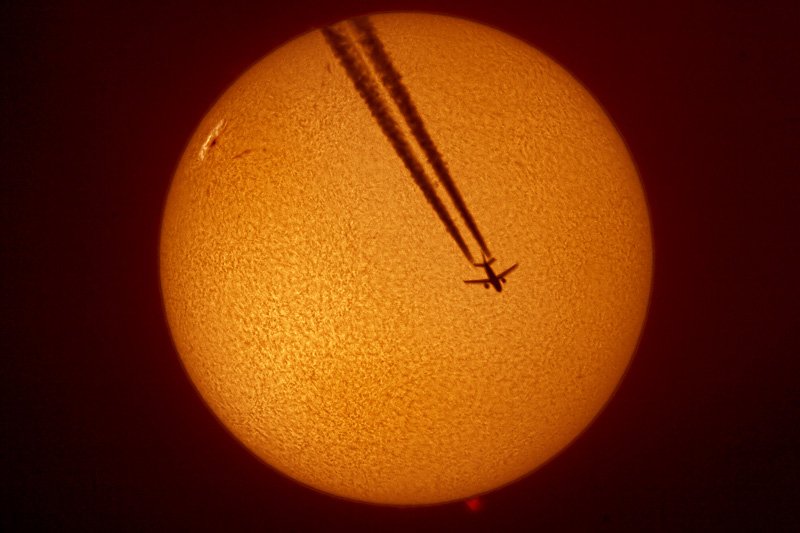
Destination sun?

Interesting image. This person was trying to make a picture of the sun through a telescope and a plane crossed the view. It looks like the destination for this aircraft is the sun? Extreme Sun Tours?

miércoles, 18 de abril de 2007

Sun's Atmosphere Sings

Erupting clouds of plasma are suspended in the Sun's hot corona. Every feature in the image traces magnetic field structure. Credit: ESA

Astronomers have recorded heavenly music bellowed out by the Sun’s atmosphere.

Snagging orchestra seats for this solar symphony would be fruitless, however, as the frequency of the sound waves is below the human hearing threshold. While humans can make out sounds between 20 and 20,000 hertz, the solar sound waves are on the order of milli-hertz—a thousandth of a hertz.

The study, presented this week at the Royal Astronomical Society's National Astronomy Meeting in Lancashire, England, reveals that the looping magnetic fields along the Sun’s outer regions, called the corona, carry magnetic sound waves in a similar manner to musical instruments such as guitars or pipe organs.

Making music

Robertus von Fay-Siebenburgen of the Solar Physics and Space Plasma Research Center at the University of Sheffield and his colleagues combined information gleaned from sun-orbiting satellites with theoretical models of solar processes, such as coronal mass ejections.

They found that explosive events at the Sun’s surface appear to trigger acoustic waves that bounce back and forth between both ends of the loops, a phenomenon known as a standing wave.

“These magnetic loops are analogous to a simple guitar string,” von Fay-Siebenburgen explained. “If you pluck a guitar string, you will hear the music.”

In the cosmic equivalent of a guitar pick, so-called microflares at the base of loops could be plucking the magnetic loops and setting the sound waves in motion, the researchers speculate. While solar flares are the largest explosions in the solar system, microflares are a million times smaller but much more frequent; both phenomena are now thought to funnel heat into the Sun’s outer atmosphere.

The acoustic waves can be extremely energetic, reaching heights of tens of miles, and can travel at rapid speeds of 45,000 to 90,000 miles per hour. “These [explosions] release energy equivalent to millions of hydrogen bombs,” von Fay-Siebenburgen said.

“These energies are plucking these magnetic strings or standing pipes, which set up standing waves—exactly the same waves you see on a guitar string,” von Fay-Siebenburgen told SPACE.com. The “sound booms” decay to silence in less than an hour, dissipating in the hot solar corona.

Solar physics

The musical finding could help explain why the Sun’s corona is so hot.

While the Sun’s surface is a steamy 10,000 degrees Fahrenheit (5,538 degrees Celsius), plasma gas in the corona soars to more than 100 times hotter.

“How can the atmosphere above the surface of the Sun be hotter if nuclear fusion happens inside the Sun?” von Fay-Siebenburgen said. If astronomers can get a clearer picture of what’s going on inside these magnetic loops in the Sun’s atmosphere, they have a better chance of finding the answer.

Another recent study using images from Hinode’s telescope revealed twisted magnetic fields along the Sun’s surface, which store huge amounts of energy. The magnetic fields can snap like a rubber band; when they do, they might release energy that could heat up the corona or power solar eruptions and coronal mass ejections, the researchers say.

Source

jueves, 22 de marzo de 2007

New Phenomena on the Sun

Nice story from NASA with great pictures and movies:

March 21, 2007: It's enough to make you leap out of your seat: A magnetic vortex almost as big as Earth races across your computer screen, twisting, turning, finally erupting in a powerful solar flare. Japan's Hinode spacecraft recorded just such a blast on Jan. 12, 2007.

Click on the image to see the movie:

Above: A solar flare in the chromosphere, recorded by JAXA's Hinode spacecraft on Jan. 12, 2007. Movies: #1, #2.

"I managed to stay in my seat," says solar physicist John Davis of the Marshall Space Flight Center, "but just barely."

Davis is NASA's project scientist for Hinode, Japanese for Sunrise. The spacecraft was launched in Sept. 2006 from the Uchinoura Space Center in Japan on a mission to study sunspots and solar flares. Hinode's Solar Optical Telescope, which some astronomers liken to "a Hubble for the Sun," produces crystal-clear images with 0.2 arc-second resolution. (Comparison: 0.2 arc-second is a tiny angle approximately equal to the width of a human hair held about 100 meters away.) "We're getting movies like these all the time now," he says.

This particular movie is visually stunning, but the most amazing thing about it, notes Davis, is where the scene unfolded--in the sun's chromosphere. "We used to think the chromosphere was a fairly uneventful place, but Hinode is shattering those misconceptions."

see captionChromosphere means "sphere of color." It's the name astronomers of the 19th century gave to a narrow and very red layer of the sun's atmosphere they saw peeking over the edge of the Moon during solar eclipses. The color comes from the chromosphere's abundant hydrogen which emits light at a wavelength of 6563 Angstroms, also known as "hydrogen alpha" light. Hinode's telescope is equipped with filters tuned to this specific color.

Right: The chromosphere, viewed the old-fashioned way during a solar eclipse. Photo credit: Vic and Jen Winter. [More]

The view from space is impressive. Visually, the chromosphere resembles a shag carpet with threads of magnetism jutting up from the floor below. Hinode's movies show the threads swaying back and forth as if blown by a gentle breeze. There is nothing gentle, however, about "spicules" shooting into the chromosphere from the underlying photosphere. "These are jets of gas as big as Texas," says Davis. "They rise and fall on time scales of 10 minutes."

And then there are the explosions. "The fact that Hinode is able to observe solar flares taking place in the chromosphere is very important," he says.

The origin of solar flares is a mystery. Researchers have long known that flares develop from magnetic instabilities near sunspots, but even after centuries of studying sunspots, no one can predict exactly when a flare is about to happen. This is a problem for NASA because astronauts in space are vulnerable to intense radiation and high-energy particles produced by the explosions. An accurate system of forecasting would help explorers stay out of harm's way.

Hinode may be looking right into the genesis zone of flares. If so, "it could teach us how flares work and improve our ability to predict them."

Meanwhile, hang on and enjoy the show.

lunes, 12 de marzo de 2007

Weekend sun

The weekend began with a blank, quiet sun--then a spectacular cloud of glowing hydrogen rose over the sun's eastern limb. "It was one of the most beautiful prominences we've had in a while," says Greg Piepol who took this picture yesterday from his backyard in Rockville, Maryland:


The surging prominence reminded photographer Gary Palmer of a giant tsunami, big enough to swallow our entire planet. Observing from a mountaintop near Los Angeles, he created a must-see movie of the wave in action: click here (7MB).

The prominence is dispersing today, but others are popping up around the sun. If you have a solar telescope, take a look.

Source: Spaceweather.com