Mostrando las entradas con la etiqueta Hatshepsut. Mostrar todas las entradas

jueves, 7 de febrero de 2008

TT71 - the tomb of Senenmut (Senmut)

From http://egyptology.blogspot.com

Photo's from TT71

Senenmut was closely associated with the female pharaoh Hatshepsut. There has been all sorts of speculation about his exact relationship with her, but officially he was the chief steward during her reign and was apparently the tutor of her only daughter Neferure. He was also the overseer of her building works at Luxor. TT71 is one of two tombs that were designed for Senenmut, the other being the larger and more ambitious TT353, which was unfinished. TT71 is a t-shaped rock-cut tomb with a passage leading to a hall with a row of 8 columns. The tomb was well decorated and produced numerous ostraca. It is not known where Senenmut was eventually buried.

The Senenmut Project has its own website, in English and Spanish.

viernes, 19 de octubre de 2007

Goddess images

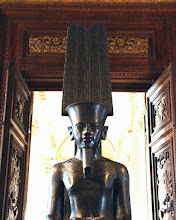
These are from Luxor, Egypt as well. First one is the goddess Mut from the Luxor museum. Mut is known as consort of the god Amun. She has her own precinct in the temple of Karnak basically "next to" Luxor. The other one is from the temple of Hatshepsut at Deir-el-Bahri, Luxor on the other side of the Nile. This is a representation of the goddess Hathor (Hethert) in her chapel of the mentioned temple.

lunes, 16 de julio de 2007

Review: Secrets of Egypt's Lost Queen

Source

While it pretty much comes down to a tooth in a box, Discovery Channel's "Secrets of Egypt's Lost Queen" (airs Sunday, July 15, at 9:00pm EST [July 17, at 8:00pm BST]) tries to cover a lot of ground: who was Hatshepsut, the early 18th Dynasty queen and pharaoh, where's her mummy, and who obliterated many of her images and inscriptions? That's a lot, even for a two-hour program.

I've watched the film twice, consulted with a couple of Egyptologists who know the subject, interviewed Egypt's archaeo-honcho Zahi Hawass, and talked with the producer, Brando Quilici (who did last year's Tut special and, before that, a documentary on the Iceman). As an archaeologist, journalist, and some-time docu-consultant, I have mixed feelings about "Lost Queen." Overall, I do think it's better than many shows out there (but is that good enough?) and unlike some past offerings from Discovery it isn't larded with superfluous re-enactments. The science is pretty neat, but I have some questions about its applications here, and there are some gaps and things that are not really explained adequately. So, it is worth watching, but although I have some criticisms.

Does it matter if we find, or identify, Hatshepsut's mummy? If you think of it only in terms of "Royal Mummies Musical Chairs" as Dennis Forbes, editor of KMT, called it in his Tombs, Treasures, and Mummies (1998), it is little more than an intellectual jigsaw puzzle. Fascinating, yes, but not necessarily a gateway to understanding ancient Egyptian culture. It's laudable that the film tries to go beyond that simple game, but it really is the hook for the show and Discovery isn't shy about playing that card. It also matters because this is an important test case. There are new techniques being applied here, especially the DNA work, that have the possibility to replace decades of conjecture with scientific evidence — if the analysis and interpretation is done right. If it isn't, then things just become more obscure than ever.

The basic structure of the film (which I'll ignore from this point on) is a bouncing back and forth between what Zahi Hawass--head of the Supreme Council of Antiquities and director of this project — is doing and the footwork of Egyptologist Kara Cooney, who talks to various archaeologists about their work at various sites and logs their various opinions about Hatshepsut. The division of labour is Hawass does the mummies and Cooney does the historical background (who was Hatshepsut, how did she move from princess to queen to pharaoh, and who tried to obliterate her name from history)...

sábado, 14 de julio de 2007

More on Hatshepsut

A 26 minute video about the CT Scan and DNA tests carried out on the mummy of Hatshepsut. This is actually quite illuminating. Zahi Hawass is very coherent on the subject, and he is ably supported by Catharine Roehrig from the New York Metropolitan Museum of Art. If you are interested in this subject, this video is informative. One of the facts that I either missed in previous reports or has been reported for the first time in this video is that the brain, which would normally have been removed, was left in place in these mummies.

There are extracts from the Discovery Channel's forthcoming Secrets of Egypt's Lost Queen, which will give you an idea of whether or not you want to watch it - it is a modern style popular documentary, with actors playing the roles of the key figures, lots of shimmering fabrics and a considerable amount of hype.

There is a transcript of the interview available on the International Herald Tribune website (easiest to read in the Printer Friendly format, because it extends over more than a dozen pages).

There is a short article about the making of the documentary on The Star Online. Further details are also to be found on the same website, with photographs provides another summary of the Hatshepsut discovery story.

domingo, 8 de julio de 2007

Secrets of Egypt's Lost Queen

Some more about her majesty Maatkare Hatshepsut. A program i can't wait to see. Although probably I'll have to hope someone puts it on the internet.

Sunday, July 15, at 9 p.m. ET/PT.

In what is being called the most important find in Egypt's Valley of the Kings since the discovery of King Tutankhamun's tomb, Discovery Channel's Secrets of Egypt's Lost Queen exclusively reveals archaeological, forensic and scientific evidence identifying a 3,000-year-old mummy as Hatshepsut, Egypt's greatest female Pharaoh.

More powerful than Cleopatra or Nefertiti, Hatshepsut stole the throne from her young stepson, dressed herself as a man, and in an unprecedented move, declared herself Pharaoh. Though her power stretched across Egypt and her reign was prosperous, Hatshepsut's legacy was systematically erased from Egyptian history — historical records were destroyed, monuments torn down and her corpse removed from her tomb.

The film follows a team of top forensic experts and archaeologists led by Dr. Zahi Hawass, Egypt's secretary general of the Supreme Council of Antiquities, as they use the full range of forensic technology to identify Hatshepsut.

The investigative journey of Dr. Hawass and his team led them through the massive crypts beneath Egypt and into the depths of the Cairo Museum. Using knowledge of royal Egyptian mummification and clues from two known tombs linked to Hatshepsut, the team narrowed their search for Hatshepsut to just four mummies from thousands of unidentified corpses.

Computed tomography (CT) scans allowed the scientists to link distinct physical traits of the Hatshepsut mummy to that of her ancestors. The search was further narrowed to two possibilities — both from the tomb of Hatshepsut's nanny — but the final clue lay within a canopic box inscribed with the female Pharaoh's name. A scan of the box found a tooth that, when measured, perfectly matched a missing upper molar in one of the two mummies.

"The discovery of the Hatshepsut mummy is one of the most important finds in the history of Egypt," said Dr. Hawass. "Her reign during the 18th Dynasty of ancient Egypt was a prosperous one, yet mysteriously she was erased from Egyptian history. Our hope is that this mummy will help shed light on this mystery and on the mysterious nature of her death."

Applied Biosystems and Discovery Quest, part of Discovery Channel's initiative to support the scientific community's work, funded the construction and equipment for the first-ever DNA testing facility located outside the Cairo Museum in Egypt for the program. The DNA testing facility will not only be used to extract and compare the mitochondrial DNA of the Hatshepsut mummy and mummies from her family, but will also be used by scientists to examine future finds in Egypt.

Dr. Zahi Hawass
Secretary General of the Supreme Council of Antiquities

Zahi Hawass currently serves as secretary general of the Supreme Council of Antiquities and director of excavations at Giza, Saqqara and the Bahariya Oasis.

Dr. Hawass is responsible for many recent discoveries in Egypt, including the tombs of the pyramid builders at Giza. He discovered the satellite pyramid of Khufu and revealed the secrets behind the so-called doors found inside the pyramid. He also excavated at Bahariya Oasis, where he discovered the Valley of the Golden Mummies. He also found the tombs of the governor of Bahariya and his family under the houses in the town of El-Bawiti. His excavations at Saqqara revealed many discoveries around the pyramid of Teti, such as the tomb of the physician Qar, and the rediscovery of the "headless pyramid." He led an Egyptian team in the examination of the mystery of King Tut’s mummy through the use of a CT scan.

Hawass is extremely concerned about the conservation and protection of Egypt’s monuments. He has carried out a major conservation project on the Great Sphinx and developed management plans for a number of important sites, including the "unfinished obelisk" quarry in Aswan and the temples of Kom Ombo, Edfu and Dendera. Currently, he is completing plans for the West Bank of Luxor, Giza and Saqqara.

Dr. Hawass' dynamic personality and extensive knowledge have sparked global interest in ancient Egypt. He has brought the world of the Pharaohs into the homes and hearts of people all over the world through his numerous television appearances and books for general audiences. Over the course of his long career, Dr. Hawass has received numerous awards and honors, including TIME Magazine's "Top 100 Most Influential People" for the year 2005. Most recently, Dr. Hawass was instrumental in sending King Tutankhamun back to the United States.

Dr. Kara Cooney
Egyptologist

Egyptologist Dr. Kara Cooney has appeared on many television programs and talk shows discussing ancient Egypt. She is an authority on the ancient language of late Egyptian, particularly hieratic ostraca and papyri from the village of Deir el Medina. Visually, she specializes in coffins and funerary art of the Ramesside period.

During the summer of 2003, Cooney worked on the return of the King Tut exhibition to the Los Angeles County Museum of Art, as well as researched a number of Egyptian pieces for inclusion in the Museum Loan Network database. She was also involved with the installation of the Cairo Museum exhibit "Quest for Immortality: Treasures of Ancient Egypt," which opened at the National Gallery of Art in Washington D.C. (where she was the Samuel H. Kress fellow) in the summer of 2002.

Cooney is currently a postdoctoral teaching fellow at Stanford University and is revising her dissertation, "The Value of Private Funerary Art in Ramesside Period Egypt," for publication. She is also working on a number of research interests, including the gender issues of death in ancient Egypt, craft specialization and funerary arts in the ancient world, the Nubian 25th Dynasty's racial identity and political legitimating process, and the socioeconomic understanding of death rituals and associated material culture in ancient Egypt. She has taught courses at Howard University and UCLA in Egyptian religion, language, literature, art and archeology.

martes, 3 de julio de 2007

Pharaoh Hatshepsut died in pain due to cancer

Queen Hatshepsut, Egypt's greatest female Pharaoh died in pain probably due to caner that spread to her pelvic bones, a new study by researchers has revealed...

Preliminary examination of the 3,000-year-old mummy has now revealed that Hatshepsut was obese, had decayed teeth and possibly suffered from a skin disease.

'Her mouth shows the presence of many dental cavities, periapical (root) inflammation and pockets,' said Ashraf Selim, radiologist at Cairo University, who examined the mummy.

The mummy also showed signs of a rather disgusting skin disease on the face and neck, which, Selim believes, might have added to Hatshepsut's health problems.

'We found numerous tiny spots within Hatshepsut and the Tuthmoside family, which could indicate a skin disease,' said Selim.

He, however, believes that the spots were more likely caused by the mummification process than dermatosis...

One thing, however, researchers say with certainty, is that Hatshepsut had cancer: cancer that had metastasized.

'The type of cancer we discovered is affecting the pelvic bone, specifically the left iliac bone. From its location, character and the few tiny foci of bone rarefaction in the spine, we concluded that this tumour is a metastatic deposit rather than a primary tumour,' said Selim.

Though Selim doesn't rule out bone cancer, he believes it was more likely another kind of tumour that spread to the bone.

'It could have been a tumour affecting the lung, breast or kidney. Whatever the tumour's origins, it is very likely that Queen Hatshepsut spent her last days in pain,' Selim said...

Pharaoh Hatshepsut died in pain due to cancer, New Kerala, India, July 03, 2007.

Pharaoh Hatshepsut Died in Pain

Obesity and poor oral hygiene suggested to Selim and colleagues that she might have suffered from diabetes.

But, Selim said, "Surely this is just a theory based on this circumstantial evidence, which we cannot confirm..."

cf. Pharaoh Hatshepsut Died in Pain, Rossella Lorenzi, Discovery Channel, USA, July 02, 2007.

TV: Secrets of Egypt's Lost Queen

Hatshepsut mania!

In what is being called the most important find in Egypt's Valley of the Kings since the discovery of King Tutankhamun's tomb, Discovery Channel's Secrets of Egypt's Lost Queen exclusively reveals archaeological, forensic and scientific evidence identifying a 3,000-year-old mummy as Hatshepsut, Egypt's greatest female Pharaoh.

The film follows a team of top forensic experts and archaeologists led by Dr. Zahi Hawass, Egypt's secretary general of the Supreme Council of Antiquities, as they use the full range of forensic technology to identify Hatshepsut...

Featuring Dr. Zahi Hawass and Dr. Kara Cooney.

Global premiere dates for Secrets of Egypt's Lost Queen:

USJuly 15 at 9:00 PM (ET/PT)
AsiaJuly 15 at 9:00 PM
Australia/NZJuly 15 at 7:30 PM
Latin AmericaJuly 15 at 9:00 PM
/ 8:00 PM (Bogota time)
UKJuly 17 at 8:00 PM
TaiwanJuly 22 at 9:00 PM
IndiaAugust 19
ItalyOctober 20 at 9:00 PM
JapanAugust TBD
ChinaAugust TBD
Europe/Middle EastAutumn 2007

Secrets of Egypt's Lost Queen, Discovery Channel, USA, July 2007.

miércoles, 27 de junio de 2007

Mystery mummy is lost female pharoah

Now that is what i call a find!

story image


The mummy of an obese woman, who likely suffered from diabetes and liver cancer, has been identified as that of Queen Hatshepsut, Egypt's most powerful female pharoah, Egyptian archaeologists said Wednesday.

Hatshepsut, who ruled Egypt in the 15th century B.C., was known for dressing like a man and wearing a false beard. But when her rule ended, all traces of her mysteriously disappeared, including her mummy.

Discovered in 1903 in the Valley of the Kings, the mummy was left on site until two months ago, when it was brought to the Cairo Museum for testing, Egypt's antiquities chief Zahi Hawass said.

DNA bone samples taken from the mummy's pelvic bone and femur are being compared with the mummy of Queen Hatshepsut's grandmother, Amos Nefreteri, said molecular geneticist Yehia Zakaria Gad, who was part of Hawass' team.

The mummy identified as Hatshepsut shows an obese woman, who died in her 50s, probably had diabetes and is also believed to have had liver cancer, Hawass said. Her left hand is positioned against her chest, in a traditional sign of royalty in ancient Egypt.

Molar in queen's jar fits in mummy's mouth

The discovery, announced Wednesday at the museum in Cairo, has not been independently reviewed by other experts.

While scientists are still matching those mitochondrial DNA sequences, Gad said preliminary results were "very encouraging."

Hawass also said that a molar found in a jar with some of the queen's embalmed organs perfectly matched the mummy.

"We are 100 percent certain" the mummy is that of Hatshepsut, Hawass told The Associated Press.

Hawass has led the search for Hatshepsut since a year ago, setting up a DNA lab in the basement of the Cairo Museum with an international team of scientists. The study was funded by the Discovery channel, which is to broadcast an exclusive documentary on it in July.

Molecular biologist Scott Woodward, director of the Sorenson Molecular Genealogy Foundation in Salt Lake City, was cautious ahead of Wednesday's announcement.

"It's a very difficult process to obtain DNA from a mummy," said Woodward, who has done such research. "To make a claim as to a relationship, you need other individuals from which you have obtained DNA, to make a comparison between the DNA sequences."

Such DNA material would typically come from parents or grandparents. With female mummies, the most common type of DNA to look for is the mitochondrial DNA that reveals maternal lineage, Woodward said.

"What possible other mummies are out there, they would have to be related to Hatshepsut," he said. "It's a difficult process, but the recovery of DNA from 18th Dynasty mummies is certainly possible."

Molecular biologist Paul Evans of the Brigham Young University in Provo, Utah, said the discovery could indeed be remarkable.

"Hatshepsut is an individual who has a unique place in Egypt's history. To have her identified is on the same magnitude as King Tut's discovery," Evans told the AP by phone from Utah.

Hatshepsut is believed to have stolen the throne from her young stepson, Thutmose III. Her rule of about 21 years was the longest among ancient Egyptian queens, ending in 1453 B.C.

Hatshepsut's funerary temple is located in ancient Thebes, on the west bank of the Nile in today's Luxor, a multi-collonaded sandstone temple built to serve as tribute to her power. Surrounding it are the Valley of Kings and the Valley of the Queens, the burial places of Egypt's pharaohs and their wives.

But after Hatshepsut's death, her name was obliterated from the records in what is believed to have been her stepson's revenge.

She was one of the most prolific builder pharaohs of ancient Egypt, commissioning hundreds of projects throughout both Upper and Lower Egypt. Almost every major museum in the world today has a collection of Hatshepsut statuary.

British archaeologist Howard Carter worked on excavating Hatshepsut's tomb before discovering the tomb of the boy-king, Tutankhamun, whose treasure of gold has become a symbol of ancient Egypt's splendor.