Mostrando las entradas con la etiqueta Egyptology. Mostrar todas las entradas

jueves, 3 de abril de 2008

Cleopatra's Suicide by Snake a Myth?

Popular lore holds that in Cleopatra's last moments, the distraught queen -- who had just lost her kingdom and learned of her lover's demise -- smuggled a poisonous snake into her locked chamber and died, along with two ladies-in-waiting, of a self-inflicted snake bite.

Such a scenario is next to impossible, according to Egyptologist Joyce Tyldesley, who shatters the "snakebite suicide" myth in her new book, Cleopatra: Last Queen of Egypt, just published in Europe and slated for an upcoming U.S. release.

"It seems to me that the snake theory is just too difficult to sustain, as it leaves too many loopholes," Tyldesley, a lecturer at the University of Manchester in England and museum fellow, told Discovery News.

She posed the following questions: Do we imagine one snake killed all three women, or were three snakes brought in? How did the snake(s) get into the room? Where did the snakes then go? Since not all snakes are poisonous, how did the women ensure their own deaths?

"Basically, I think there are better and more reliable ways of killing oneself," she said, adding that some elements of the story are probably true.

Based on a number of historical accounts, Cleopatra did die in Alexandria at around 30 B.C., and there is no historical evidence of a prior illness. The moments leading up to her death are also plausible to Tyldesley, particularly Cleopatra's dismissal of her servants, save for two women, Charmian and Eiras.

"The decision to die in front of her female servants made good practical sense, as even the dead (according to ancient Egyptian spiritual beliefs) needed a chaperone," she explained.

"One of the horrors of female suicide was that the body might be glimpsed partially naked, by strangers," she added. The queen therefore safeguarded her virtue in life and in death by retaining the company of her ladies-in-waiting.

In accounts written about by the Greek historian Plutarch and the Roman historian Cassius Dio, Cleopatra had a snake smuggled into her chamber inside a jar of figs or water, but both historians expressed doubts about the scenario.

Tyldesley said the most likely snake would have been an Egyptian cobra, which, while slender, can grow up to 6 feet in length.

"An adult cobra, or three, would have needed an exceptionally large fig basket or water jar," she wrote.

She believes instead that Cleopatra and her servants died of self-administered poison, which might have been smuggled into the room or worn on the queen in a pin or hair comb. One of Cleopatra's uncles committed suicide by ingesting poison; death by suicide was seen as a virtue in the Greek tradition her family practiced.

Cleopatra might have "chosen to die on her own terms rather than wait to be killed or humiliated by Octavian," who defeated Antony and Cleopatra at the Battle of Actium and later became the Roman Emperor Augustus, said Tyldesley.

Some researchers even believe Octavian murdered Cleopatra. U.S. criminal profiler Pat Brown took on the case in 2004 and approached it as she would investigate a 21st century death.

Brown also found flaws in the snakebite scenario. With the help of University College London Egyptologist Nicole Douek and Oxford University professor David Warrell, she came to the conclusion that Octavian "sent his men in to do the job" and then made it look like suicide.

Tyldesley agrees Octavian would have "wanted Cleopatra dead, although the argument that he wished to end the troublesome Ptolemaic line once and for all holds little water when we consider that he spared the lives of three of Cleopatra's children and allowed Cleopatra's daughter to marry and have children of her own."

As for the snake myth, Tyldesley thinks it arose because the Egyptians feared, respected and worshipped snakes. Cleopatra might have therefore worn a crown with a snake depicted on it, which artists latched onto, perhaps with too much fervor.

"Later artists picked up on the royal Egyptian snake idea and ran with it...fuelling speculation that she died by snakebite," said Tyldesley.

Intact Colossus of Egypt's Queen Tiye Found

This intact statue of Queen Tiye, a powerful queen from ancient Egypt's 18th dynasty, was recently discovered at the site of the mortuary temple of powerful pharaoh Amenhotep III, as seen in this photograph taken March 27, 2008.

The 12-foot-tall (3.6-meter-tall) quartzite figure was found attached to the broken-off leg of a much larger colossus—a 50-foot-tall (15-meter-tall) likeness of Amenhotep III seated at his throne.

Experts said the statue is one of the best preserved at the site, ancient Egypt's largest temple complex that most believe was decimated in antiquity by massive earthquakes.

More images on source

sábado, 29 de marzo de 2008

Study shows life was tough for ancient Egyptians

Everything was tough under Akhenaten. No gods , no life.

"CAIRO, March 28 (Reuters Life!) - New evidence of a sick, deprived population working under harsh conditions contradicts earlier images of wealth and abundance from the art records of the ancient Egyptian city of Tell el-Amarna, a study has found.

Tell el-Amarna was briefly the capital of ancient Egypt during the reign of the pharaoh Akhenaten, who abandoned most of Egypt's old gods in favour of the Aten sun disk and brought in a new and more expressive style of art.

Akhenaten, who ruled Egypt between 1379 and 1362 BC, built and lived in Tell el-Amarna in central Egypt for 15 years. The city was largely abandoned shortly after his death and the ascendance of the famous boy king Tutankhamun to the throne.

Studies on the remains of ordinary ancient Egyptians in a cemetery in Tell el-Amarna showed that many of them suffered from anaemia, fractured bones, stunted growth and high juvenile mortality rates, according to professors Barry Kemp and Gerome Rose, who led the research.

Rose, a professor of anthropology in the University of Arkansas in the United States, said adults buried in the cemetery were probably brought there from other parts of Egypt.

"This means that we have a period of deprivation in Egypt prior to the Amarna phase," he told an audience of archaeologists and Egyptologists in Cairo on Thursday evening.

"So maybe things were not so good for the average Egyptian and maybe Akhenaten said we have to change to make things better," he said.

Kemp, director of the Amarna Project which seeks in part to increase public knowledge of Tell el-Amarna and surrounding region, said little attention has been given to the cemeteries of ordinary ancient Egyptians.

"A very large number of ordinary cemeteries have been excavated but just for the objects and very little attention has been paid for the human remain," he told Reuters.

"The idea of treating the human remains ... to study the overall health of the population is relatively new."

Paintings in the tombs of the nobles show an abundance of offerings, but the remains of ordinary people tell a different story.

Rose displayed pictures showing spinal injuries among teenagers, probably because of accidents during construction work to build the city.

The study showed that anaemia ran at 74 percent among children and teenagers, and at 44 percent among adults, Rose said. The average height of men was 159 cm (5 feet 2 inches) and 153 cm among women.

"Adult heights are used as a proxy for overall standard of living," he said. "Short statures reflect a diet deficient in protein. ... People were not growing to their full potential."

Kemp said he believed further excavations in Tell el-Amarna would "firm-up" the conclusions of his team.

"We are seeing a more realistic picture of what life was like," he told Reuters. "It has nothing to do with the intentions of Akhenaten, which may have been good and paternal toward his people." (Writing by Alaa Shahine, editing by Mary Gabriel)"

Nefertiti's tomb found?

Now how about that. I wonder how that follow-up will be.

"BASEL, Switzerland, March 11, 2008.

Nefertiti's Tomb found? Sensational discovery in the Egyptian Valley of the Kings! Once again, a new tomb was discovered underneath the desert sands, as reported by the German-language MYSTERIES Magazine in its next newsstand issue.

So far, the Egyptian Department of the Antiquities has kept silent about the exact location of this discovery. As MYSTERIES has now revealed exclusively on its webpage, the tomb, which was discovered in November 2007, is allegedly located in very close vicinity of King Meren-Ptah (KV 8). Could it be the last resting space of Ramesses VIII? Hardly, because the discovery appears to be a "stepped entrance" which points to a significant Amarna Ruler Tomb from the 18th Dynasty - possibly even to the legendary and elusive last resting place of Pharaoh Akhenaten or his wife Nefertiti!

After the discovery of King Tut's tomb in 1922 and the Tomb Depository KV 63 in 2006, this is only the third significant discovery in the Valley of the Kings in the last 85 years. It can be expected that Zahi Hawass will hold an international press conference soon informing the public about this sensational discovery, especially since he also made another "significant discovery" with the famous tomb of Pharaoh Sethos I."

lunes, 3 de marzo de 2008

Royal Egyptian mummy in Bolton Museum (UK)

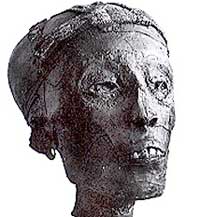
And now the question is: Who can she be??

Only too bad i couldn't find a better image.

From the Bolton News: "A member of royalty has been in Bolton for the last 78 years - in the shape of an Egyptian mummy which is more than 3,000 years old. Experts carried out a series of examinations - including CT scans at the Royal Bolton Hospital - on two mummies from Bolton Museum. And the results for one of the relics were unexpected. For they revealed that the Eygptian mummy, originallly thought to be an Egyptian temple dancer, was in fact a member of the Egyptian royal family from the 19th dynasty, related to Ramesses the Second."

sábado, 16 de febrero de 2008

Nefertiti's Eyes

Did the queen's distinctive feature become a symbol of Egyptian royalty?

Below: Coffin F is one of three from KV63, an embalmer's cache from around the time of Tutankhamun, that shows faces with eyes shaped similarly to Nefertiti's. (Heather Alexander/Amenmesse Project)

All eyes were on the Valley of the Kings the morning of February 5, 2006, when our expedition first looked into the chamber now known as KV63, the first tomb found in Egypt's Valley of the Kings since that of Tutankhamun (KV62) in 1922.

Press speculation was rampant over what the tomb might hold. Would our expedition find the mummies of royal women from the late 18th Dynasty, such as Queen Nefertiti, thought by some to be Tut's mother? Or the six princesses she bore to the pharaoh Akhenaten, including Tut's queen, Ankhesenamun? The mummies of these women have either not been found or identified. Perhaps they were removed from Akhenaten's capital at Amarna when a later king, presumably Tut, returned to the traditional capital of Thebes on the Nile opposite the Valley of the Kings. Did Tut rebury them in the Valley?

After taking out several stones blocking the doorway from the tomb shaft into the chamber, we peered through the narrow opening. Inside, we could see many large ceramic jars and several wooden coffins, some with yellow-painted faces. The press speculation was incorrect on all counts. We found no mummies in any of the tomb's seven coffins and no inscriptions to tell us for whom these coffins were initially intended.

But while studying the coffins, I discovered--in the eyes of faces painted on three of them--an intriguing link to Nefertiti, the queen whose name means, simply, "the beautiful one has come." While none of the coffins held Nefertiti's remains, the eyes may tell us something unexpected about her celebrated beauty. Was it in part the result of a genetic syndrome?

If not a royal tomb, what was KV63? Finds include the seven coffins, a small gilt coffinette, two large alabaster vessels, floral garlands, pillows, natron (the natural salt used in mummification), and many ceramics. It seems to have been a cache of material used by embalmers, but including coffins, unused or salvaged from disturbed burials, suitable for upper-class, but not elite or royal, funerals.

Although KV63 didn't yield the mummies of Nefertiti, Ankhesenamun, and the rest, the tomb is linked to Tutankhamun's time. Seal impressions found there match some discovered in Tut's tomb, which is just 50 feet away. KV63's date should fall within or close to Tut's reign (1343-1333 B.C.), but association with his burial is uncertain at this point. Perhaps we will gain further evidence for the date of KV63 from the contents of the remaining 16, of 28 total, storage jars that we plan to open this season.

Otto Schaden, our expedition director, asked me, as staff art historian and object analyst, if any information could be gleaned from the coffins to narrow this date range. I began with the four coffins that had yellow-painted faces. The KV63 coffins were almost totally destroyed by termites, but the faces were made separately. Faces on coffins were often covered with thin plaster or gesso as a base for gilding or painting (as in the KV63 coffins). The termites seem to prefer untreated wood, so while the remainder of the coffins were mostly consumed, the gessoed and painted faces survived.

In the art of the ancient Near East, including Egypt, females were generally depicted with lighter skin than males. Were the coffins with light yellow faces made for women? Two such coffins in museum collections, however, were inscribed for males. Furthermore, a painting in a tomb in Thebes shows coffins of Nebamun and Ipuky, sculptors who worked during the reigns of kings Amenhotep III and his son Akhenaten. Each of their black coffins has a yellow-painted face. So rather than indicating the coffins were for females, the yellow faces probably copied those of the very wealthy, who could afford gold faces on their coffins.

With no inscriptions and the ambiguous nature of the yellow face color, I began looking at other characteristics that might prove helpful, such as the shape and details of the faces. In doing that, the eyes on three of the painted KV63 coffins brought me back to Nefertiti.

Nefertiti is best known from the painted bust of her found at Amarna and now in Berlin. Her parentage is not entirely certain, but most Egyptologists believe she was the daughter of the powerful courtier Ay, who eventually succeeded Tutankhamun.

The face of one, which we designated coffin A, had eyes rimmed with blue glass in a traditional shape, unlike the other three coffins with yellow faces, designated B, F, and G. What links the eyes of these three coffins, beside the fact that all are painted, is that the inner canthus--the corner of the eye near the nose--descends abruptly and abuts the upper lid, giving them an East Asian appearance. Nefertiti's famous bust illustrates this eye shape better than words. Both her proper right eye and the empty socket of the left show this form. What is the meaning of this eye shape?

Art of the Amarna period, when Akhenaten and Nefertiti reigned, is noted for its naturalistic depiction of plants and animals and, in some cases, candid scenes of daily life. So one might suggest that the shape of Nefertiti's eyes may be an attempt to render her features as they actually appeared.

One of the earliest appearances of Nefertiti's unusual eye shape is on a stela showing the royal family. Found at Amarna and now in Berlin, it is dated by an inscription to before years 8 through 12 of Akhenaten's reign, or around 1350 B.C. On the stela, however, Akhenaten's eye shape is "normal" and resembles those seen on sculptures of him in Thebes, but Nefertiti's is not. So this stela may show a real, physical condition.

It could be that Nefertiti had an epicanthic fold, a piece of skin from the upper eyelid covering the inner edge of the eye. This feature is found not just in people of East Asian descent, but also in individuals with a number of different syndromes--groups of symptoms characteristic of an abnormality--some of which are genetically based. Some syndromes are debilitating, others less so, and still others are passed only from mothers to daughters. We are currently investigating the possibility that Nefertiti's eyes reflect such an underlying physical condition, but without her remains no diagnosis can be made (and the evidence may have been destroyed or altered during mummification).

If a genetically based physical trait was the basis for this eye shape, did Nefertiti pass it on to her children and was it recorded in the appearance of their eyes in artwork? Images of Nefertiti show the trait more frequently and markedly than those of any other individual portrayed at Amarna. German excavators at Amarna in 1912 found many representations of Nefertiti and her daughters in the studio of an artist named Tuthmosis, including the painted bust of Nefertiti. Many of these representations are in various stages of completion, but their distinctive eyes are easily noticed. This is especially clear in a relief, now in the Brooklyn Museum, that may show Meritaten, the queen's eldest daughter.

It is possible that Nefertiti was Tutankhamun's mother. If so, it wouldn't be surprising if he were shown with an eye shape similar to hers. This is the case with some depictions, such as a wooden head of the young pharaoh that was found in his tomb. It shows his head, sprouting from a lotus bloom, with eyes that match those of Nefertiti. Other explanations for its appearance with Tut include the possibility that his mother was not Nefertiti but perhaps a woman of the extended royal family who also carried the trait. And it could even be that Tut did not have the eye shape himself, if his mother was a woman other than Nefertiti who did not have it or if the trait was passed only from mothers to daughters. In either case, Tut could be shown with it simply as an artistic continuance of the characteristic.

If the sculptor Tuthmosis were responsible for recording and then re-creating this eye shape, perhaps he extended its use from those who actually had it to--as an artistic convention--a "royal marker" to distinguish images of the king and a few select nobles. For example, this eye shape is also seen on a representation of King Amenhotep III, Akhenaten's father, seated in a relaxed pose with his wife Queen Tiy on a stela found at Amarna, and now in the British Museum. Amenhotep III was Nefertiti's father-in-law, but this stela was probably carved after his death, so the eye shape does not predate its appearance on Nefertiti. It is also used in the 19th Dynasty, such as in depictions of the pharaoh Seti I at Abydos and of Nefertari, queen of Rameses II, who died around 1254 B.C.

And this brings us back to KV63, with its upper-class coffins. Like the yellow faces meant to represent gilding, did the eye shape seek to portray a "royal marker" derived from Nefertiti's own eyes?

The final word is not yet in, but there seems to be a high probability that Nefertiti herself had eyes with epicanthic folds or eyes with a similar shape with descending inner canthi. Eyes of this type undoubtedly created what must have been quite a striking feature to all who saw her. This may have been passed along to some of her royal offspring. Moreover, in the sun cult that they fostered, both Nefertiti and her husband Akhenaten were the only ones through whom prayers could be directed to the solar god Aten. This divine or semi-divine status may have accounted for this eye shape being transformed into an artistic convention that was copied by high-ranking officials and subsequent rulers.

jueves, 7 de febrero de 2008

TT71 - the tomb of Senenmut (Senmut)

From http://egyptology.blogspot.com

Photo's from TT71

Senenmut was closely associated with the female pharaoh Hatshepsut. There has been all sorts of speculation about his exact relationship with her, but officially he was the chief steward during her reign and was apparently the tutor of her only daughter Neferure. He was also the overseer of her building works at Luxor. TT71 is one of two tombs that were designed for Senenmut, the other being the larger and more ambitious TT353, which was unfinished. TT71 is a t-shaped rock-cut tomb with a passage leading to a hall with a row of 8 columns. The tomb was well decorated and produced numerous ostraca. It is not known where Senenmut was eventually buried.

The Senenmut Project has its own website, in English and Spanish.

martes, 30 de octubre de 2007

Unearthing Egypt's Greatest Temple

Archaeologists are finally grasping the true grandeur of the monument built 3,400 years ago by Pharaoh Amenhotep III

"Heya hup!" Deep in a muddy pit, a dozen workers wrestle with Egypt's fearsome lion goddess, struggling to raise her into the sunlight for the first time in more than 3,000 years. She is Sekhmet—"the one who is powerful"—the embodiment of the fiery eye of the sun god Ra, but now she is caked in dirt and bound by thick rope. As the workers heave her out of the pit and onto a wooden track, the sand shifts and the six-foot-tall granite statue threatens to topple. A half-dozen men in ankle-length robes grab the taut ropes, again shout the Arabic equivalent of "heave, ho!" and steady her just in time.

Within the hour, the seated Sekhmet is once again imperious: her breath creates the desert wind, her anger feeds on disease and war, and her power protects mighty pharaohs. Or did. This long-buried statue is one of 730—one for every day and night of the year—that guarded a vast collection of gates, colonnades, courts and halls built by the great Egyptian king Amenhotep III, who reigned over Egypt for 38 years in the 14th century B.C., at the height of peace and prosperity. In its day, "The House of Millions of Years" was the largest and most impressive temple complex in the world. But it was no match for earthquakes, fires, floods or Amenhotep III's successors, who scavenged stone blocks and statues for their own temples. Much of the site, near the Valley of the Kings along the west bank of the Nile River, is covered with sugar cane.

Hourig Sourouzian, an Armenian archaeologist, is directing the effort to rescue the long-neglected site and its many statues. "They didn't deserve this treatment!" she says as a worker hoses off the mud and salt coating a Sekhmet lined up with a dozen similar statues in the bright sun.

Egyptologists had long assumed that all that remained of the temple complex were the imposing Colossi of Memnon, two seated statues of Amenhotep III at the entrance to his temple, and some stones and fragments of statuary. Sourouzian had been working at a neighboring temple, Merentptah, from which she would visit the Amenhotep complex. "I was always interested in the fragmented statuary of the site and dreamed about seeing them reconstructed instead of lying in vegetation, water and junk," she recalls. Then, in 1996, a brush fire swept over the area, charring the stones and fragments and making them more vulnerable to cracking and erosion. When Sourouzian and her husband, German archaeologist Rainier Stadelmann, surveyed the damage, she says, "It was terrible and depressing, and we swore to take action."

First, she convinced the World Monuments Fund in 1998 to designate the temple one of the world's "100 Most Endangered Sites" and fund the initial conservation area of the shattered fragments aboveground. During the course of that effort, Sourouzian began to suspect that there was more to be found underground. By 2000, however, the money had run out, and she and Stadelmann reluctantly began to wrap up their work. But a wealthy French woman who had attended a lecture by Sourouzian in Paris agreed to fund a more ambitious excavation. Within a year, the team began to uncover their first statues, and the archaeologists realized that many treasures still lay beneath the dirt.

Born in Baghdad to parents of Armenian descent, Sourouzian grew up in Beirut and studied art history at the Sorbonne in Paris. Sent to Karnak by the Louvre, she became one of the leading authorities on Egyptian royal statuary. "She's probably the best Egyptian art historian of our time," says Betsy Bryan, an Egyptologist at Johns Hopkins University. Now, along with Stadelmann, who once headed the German Archaeological Institute in Cairo, Sourouzian orchestrates a team of two dozen specialists from around the world—including French, Swiss, German, Spanish and Japanese researchers—and as many as 400 local workers.

What began modestly has become one of the most ambitious projects Egypt has seen in decades, bringing to light a triumph of engineering and art that once dwarfed even the massive Karnak and Luxor temples across the Nile. Amenhotep III called the complex "a fortress of eternity out of good white sandstone—worked with gold throughout. Its floors were purified with silver, all of its doorways were of electrum," an alloy of gold and silver.

The recently liberated Sekhmet statue is one of 72 of the goddess that Sourouzian and her team have discovered. They've also found two huge statues of Amenhotep III, each flanked by a smaller one of Queen Tye and a menagerie of sacred animals, including an alabaster hippopotamus. The project is giving Egyptologists a fresh look at the mysterious temple culture that dominated ancient life here, in which hordes of priests conducted rituals, made offerings and administered the intricate rites designed to ensure the eternal well-being of the dead pharaoh.

Once brightly painted in blues, reds, greens, yellows and whites, the 50-foot colossi in front of the massive first gate, or pylon, loomed over the Nile Valley's flat farmland, facing the brown river that then flowed just a few hundred yards away. While the rest of the complex collapsed and crumbled, the stately statues remained. Cracks caused by an earthquake in 27 B.C. made one of the statues produce an odd tone when the morning sun struck it. A contemporary named Pausanias described the sound in his Guide to Greece as "very like the twang of a broken lyre-string or a broken harp-string." The site quickly became one of the ancient world's biggest tourist attractions; even the Roman emperor Hadrian came to hear it in A.D. 130. Alas, it was inadvertently silenced during restoration work in A.D. 199.

On a hot morning, visiting American archaeologists and art conservators spill out of a crowded van. Sourouzian leads them into a storeroom the length of a railroad car, and the visitors marvel at the Sekhmets, a giant head of the pharaoh, and bits and pieces of unidentified faces in neat rows—fresh finds from Sourouzian's team. "She's Isis reassembling Osiris," says the University of Chicago archaeologist Ray Johnson, of Sourouzian, likening her to the goddess who recovers dismembered pieces of her lover and restores him to life.

Few building sprees in history can match that of Amenhotep III, and few pharaohs' lives are so well documented—even his birth is commemorated in stone reliefs at Luxor. He came to the throne before his teens, at the death of his warrior father Thutmose IV. His grandfather and father had expelled Mesopotamian invaders known as the Mitanni. The young pharaoh quelled an uprising in Nubia at the southern fringe of his empire—chopping off the right hands of 312 enemies—but turned to diplomacy for the rest of his reign.

His principal wife, Tye, was from a noble Egyptian family, but Amenhotep III's harem grew to include princesses from great powers such as Babylon and Mitanni—a common method of cementing alliances in the ancient world, but unusual for Egypt, whose rulers tended to disdain foreigners. He also maintained regular correspondence with other kings. Letters written in Mesopotamian cuneiform found at Amarna, the capital built by his son Akhenaten, reveal a canny leader who preferred words to weapons.

The peace that Amenhotep III worked hard to preserve brought a boom in international trade, with partners from throughout the Mediterranean, across Western Asia and deep into Africa—thanks in part to Egypt's many gold mines. "Gold in your country is dirt; one simply gathers it up," wrote an obviously envious Assyrian king. The pharaoh used his wealth to transform the nation into an imperial showplace. He ordered temples built from the Nile Delta in the north to Nubia 800 miles to the south. Under his patronage, artists experimented with new styles of sculpture and reliefs carved into temple walls. Traditional rudimentary forms became elegant and sophisticated, and the carvings reveal more attention to craft and detail. It was "probably the highest-quality art Egypt ever made," says Johns Hopkins' Betsy Bryan. "The man had taste!"

Amenhotep III reserved the greatest works for his hometown, Thebes, today's Luxor. During most of the so-called New Kingdom, which lasted from 1570 B.C. to 1070 B.C., pharaohs resided at Memphis, a cosmopolitan city near today's Cairo. But as Amenhotep III grew older, he spent more and more time in Thebes, turning it into one vast religious center spanning both sides of the Nile. Large additions were made to the Karnak and Luxor temples on the Nile's east bank, both of which had begun as small Middle Kingdom sanctuaries. Across the river, Amenhotep III built a huge harbor and an adjacent palace with colorfully painted walls, as well as his extensive funerary temple.

It was this great temple, rather than his hidden tomb in the Valley of the Kings, that Amenhotep III counted on to ensure his soul's journey to the afterlife—and, no doubt, inspire awe among the living. Stretching seven football fields in length from the colossi at the main entrance, which faced east to the Nile, to sacred altars pointing toward the Valley of the Kings in the west, the complex covered an area nearly the size of Vatican City. In its day, it was the largest and one of the most ornate religious structures in the world, filled with hundreds of statues, stone reliefs and inscriptions set among colonnaded plazas. Colorful royal banners flapped from cedar poles shimmering in gold leaf and secured on red granite pedestals at pylons, or massive gateways, that led into innumerable sanctuaries.

Such an awesome sight is hard to envision today. In addition to an earthquake a century or so after Amenhotep III's death that toppled its columns and walls, successive pharaohs raided it for their own temples. Ramses II took two seated colossi in the 13th century B.C., and the site was still being scavenged a thousand years later. The earthquake in 27 B.C. toppled much of what remained. Nineteenth-century treasure hunters carted off what they could find from the rubble—sphinxes to embellish the Neva River embankment in St. Petersburg, royal statues to London's British Museum and a head of the pharaoh to the Louvre in Paris. Excavations from the 1950s through the 1970s revealed little more than scattered stone fragments and artifacts.

Today's most insidious threat is the slow rising of groundwater. In the past, the Nile flooded annually, replenishing fields along the river before retreating to within its banks. (Some scholars, though not Sourouzian, believe Amenhotep III's temple was designed to allow the holy Nile floodwaters to wash through the gates and plazas.) Since the Aswan High Dam was completed in 1970, the Nile waters no longer surge over its banks (and the river is two miles from the temple site), but sugar cane farmers irrigate year-round, turning the desert into soggy soil. The water carries salts that eat away at stone, particularly more porous varieties such as limestone and sandstone.

On a spring morning, the huge field, bordered by sugar cane and the road to the Valley of the Kings, resembles a busy construction site. At the spot where a pylon once stood behind the Colossi of Memnon, researchers sit under tarps, patiently sorting and photographing fragments from one of two smaller colossi that fell in antiquity. The head of one of them alone weighs 25 tons, and nearly 200 workers and a winch were required to pull the broken statue out of the mud. Sourouzian hopes to re-erect those statues—each torso weighs 450 tons—once the ground dries and a secure foundation can be built.

Nearby, an alabaster statue of a crocodile and two more statues of Amenhotep III, also in alabaster, wait to be cleaned. Remains of massive sandstone columns are in rows of three and four. The columns formed the edges of the great peristyle hall, or sun court, and once stood on crude blocks and gravel. "Obviously, they were cutting corners here and there," says Theodore Gayer-Anderson, a British archaeologist on the team. "They weren't the ideal builders." The stubs of the columns are fragile, and to coax out salt, which is corrosive, Gayer-Anderson coats them in a poultice of deionized water, cellulose powder and mineral powder. Each wrapping must be changed every two days. "It's impossible to eliminate the salt," he says. "But you can cleanse the skin to a stable level."

A few yards away, a seven-ton torso of Amenhotep III dangles below an iron tepee, as workers prepare to marry it to a base covered in protective scaffolding. The statue's head was found a century ago and is now in the British Museum. The museum has promised to send a cast of the head to be placed on the torso next spring. An Egyptian foreman barks at the workers as the torso is raised into place, while a Spanish archaeologist paces across some beams. "I'm not nervous—that wouldn't help," he announces.

This is the first of five 25-foot-high statues of Amenhotep III that the team intends to re-erect. The statues once stood between the columns. On the north side of the peristyle hall, the statues are made from quartzite from near today's Cairo and they wear the chair-shaped crown of lower Egypt (that is, northern Egypt, which lies downstream along the Nile). On the south side, the images are made from Aswan's red granite and wear the white conical headpiece of upper Egypt. In addition to the statues of the pharaoh, which were in fragments, an alabaster hippopotamus surfaced, minus head and tail, along with six standing statues of Sekhmet, beautifully preserved, each holding a papyrus bundle in one hand and an ankh—the symbol of life—in the other.

The excavation is only in its initial phases and could take two decades or more. To the west of the peristyle hall was a hypostyle hall, a vast interior space that once had a roof supported by massive columns. It no doubt holds more statues and artifacts. "You would need years and millions of dollars to excavate," says Sourouzian, looking with a touch of longing over the bare ground. "What's more urgent is to save the statues, preserve the last remains of the temple and present it with dignity."

miércoles, 10 de octubre de 2007

Tutankhamun's mummy to Be Displayed for 1st Time

The mummy of King Tutankhamun will soon go on display for the first time, exposing the bare face of the boy king, Egyptian officials have announced. The mummy will be removed from its sarcophagus and placed in a climate-controlled glass case in the antechamber of the pharaoh's tomb in Luxor in November (see Egypt map).

"I am taking [the mummy] out to show it to the public for the first time," said Zahi Hawass, secretary general of Egypt's Supreme Council of Antiquities.

The move is part of an effort to preserve the mummy, which has been in poor condition since it was first discovered, Hawass explained.

Archaeologist Howard Carter unearthed Tutankhamun's treasure-filled tomb in 1922, the first discovered with its riches so intact.

But Carter and his team partly destroyed the mummy in search of more treasures buried with the pharaoh, separating it into 18 sections, Hawass said.

Humidity and heat, much of it generated by the breath of the tomb's 5,000 daily visitors, have also taken a toll.

"Right now the mummy has no special protection from the humidity in the tomb," Hawass said. "The new case will be specially sealed to protect it from this sort of damage."

The pharaoh's remains will be partially rewrapped in linen with the face of the pharaoh left uncovered, according to Mansour Boraik, general supervisor of the Supreme Council of Antiquities in Luxor.

Officials hope the display will increase the number of visitors and generate profit for the conservation of other Egyptian antiquities.

"The 'golden boy' has magic and mystery that bring people from all over the world," Hawass said.

(Hawass is a National Geographic Society explorer-in-residence. National Geographic News is a division of the National Geographic Society.)

The mummy has been examined four times before, but it has never been seen by the public.

In 2005 Hawass opened the sarcophagus to perform a series of CT scans that allowed researchers to create a reproduction of the king's face.

(See photos of Tut's mummy and reconstructed face.)

"I was fascinated with his face," said Hawass, who noted the king's buck teeth are similar to those of the pharaoh's royal ancestors.

"Meeting King Tut face to face was very personal. … It was an important moment in my life."

Tutankhamun became pharaoh at the age of nine, ruling for only ten years in the 14th century B.C. before meeting an untimely death.

(Read: "King Tut Died From Broken Leg, Not Murder, Scientists Conclude" [December 1, 2006].)

Awakening the Curse

Exposing the mummy is likely to resurrect the myth of the pharaoh's curse, once believed to bring tragedy to those who disturb the tomb.

Most famously, Carter's sponsor, Lord Carnarvon, died shortly after entering the tomb from an infected mosquito bite.

Other tragedies were also blamed on the curse, and some experts have said ancient toxins lying in the tomb could have played a role.

"There is always mystery about King Tut, and it will never stop," Hawass said.

"Of course this will reawaken fears of the curse, as any new project involving the tomb or the mummy always does."

"I don't believe in the curse at all," he added. "But the gold, the intact tomb, the curse—all this history makes everybody fascinated by King Tut."

jueves, 4 de octubre de 2007

OsirisNet updated with tomb of Amenhotep III

Also from: http://egyptology.blogspot.com/

As usual, an enormous amount of work has gone into providing a complete overview of the tomb, including descriptions of the tomb and its contents, translations, site plans, diagrams, individual photographs, slideshows and a bibliography.

The photographs of the tomb were taken after completion of the restoration work (a single sample from many more displayed on OsirisNet is shown in this post), and Thierry believes that they may be the only photographs of the tomb in this condition on the web.

Ancient Egypt Magazine - Free PDF Downloads

Source: http://egyptology.blogspot.com/

Ancient Egypt Magazine download page

Ancient Egypt magazine has, for some time now, offered the alternative to download PDF versions of the entire magazine for a fee. They are also offering two issues no longer available in print for download, free of charge. These are the issues available:

Volume 7, Issue 2 which includes the final excavation report of KV63
(for full table of contents click here).

Volume 2, Issue 3, No.9
(for table of contents click here)

There's also a free 8 page sample of Volume 7, Issue 1.

miércoles, 3 de octubre de 2007

Egypt to put Tutankhamun mummy on display in tomb

EGYPT will put the mummy of the boy pharaoh Tutankhamun on display next month inside his tomb in Luxor's Valley of the Kings, allowing visitors to see his face for the first time, Egypt's chief archaeologist said overnight.

Zahi Hawass, head of the High Council for Antiquities, said he would place the mummy in a climate-controlled glass showcase in the tomb and cover the body with linen. Tutankhamun's bare face would be visible.

"You will enter the tomb and see for the first time the face of Tutankhamun ... This is the first time in history that anyone will see the mummy (in public). This will continue the magic of Tutankhamun," Mr Hawass said.

Tutankhamun, who died on the cusp of adulthood, ruled Egypt between about 1361 and 1352 BC. The 1922 discovery of his intact tomb, whose treasures included a now famous gold funerary mask, stunned the archaeological community.

Although the artefacts from Tutankhamun's burial tomb have toured the world, the mummified body of the king has been examined only a handful of times in detail since the tomb was discovered by British archaeologist Howard Carter.

Mr Hawass said Tutankhamun's mummy was currently resting in a sarcophagus inside the tomb covered by a gilded coffin, but that the humidity caused by the breathing of thousands of visitors threatened to damage it.

"I thought that this will help tourists and at the same time help preserving the mummy. I think a mummy like this, the golden boy, it is time that people should really see it," he said.

Tutankhamun came to the throne shortly after the death of Akhenaten, the maverick pharaoh who abandoned most of Egypt's old gods in favour of the Aten sun disc and brought in a new and more expressive style of art.

During Tutankhamun's reign, advocates of the old religion were regaining control of the country and turning their backs on Akhenaten's innovations.

Tutankhamun was buried along with many other pharaohs of the period in the Valley of the Kings near the modern town of Luxor.

Mr Hawass had not yet set a date to display the mummy, but said he expected it to be shortly before a mid-November exhibit on Tutankhamun in London that is to include the pharaoh's royal crown but not the gold mask, which is too delicate to travel.

Mr Hawass described Tutankhamun as having "buck teeth" and pictures of the mummy show a face with high cheekbones and blackened, cracked skin and an intact nose.

Mr Hawass was also planning to shortly open 16 jars from Tutankhamun's tomb that were rediscovered in a storage area in Luxor. The jars were originally found by Carter but were forgotten about over the years.

He said he expected the jars would contain food, grain, beer and wine, items the king would have been expected to need in his afterlife. The jars were part of caches of artefacts whose rediscovery was announced last month.

Mystery has surrounded Tutankhamun ever since 1922. Lord Carnarvon, Carter's sponsor and among the first to enter the tomb, died shortly afterward from an infected mosquito bite.

Newspapers at the time said Carter had unleashed a pharaonic curse that killed Carnarvon and others linked to the discovery.

Scientists have in the past suggested a disease lying dormant in the tomb may have killed the British aristocrat.

miércoles, 26 de septiembre de 2007

Philae look through

I believe this is the temple of the goddess Aset (Isis) at Philae, Egypt. A nice look through into the sanctuary. Normally at daytime it's pretty crowded with tourists.

Aswan sunrise

Southern Egypt at Aswan and a sunrise at the Nile River

Karnak column

From the temple of Amun-Ra at karnak this huge column. The sun as you can see is behind the column. The sun also a major symbol in Ancient Egypt.

Polish atomic physicists study Egyptian frescoes

Thousands of years ago, Egyptians knew many complicated methods of producing dyes. They used them to create many magnificent frescoes, which cover the walls of temples, royal palaces and tombs. Time and atmospheric factors have caused the paintings to lose their initial colours. The chemical reactions have modified the chemical content of the pigment. Thus, the colours we see today, are very distant from the pieces created by their ancient painters.

This is why scientists, with the help of modern knowledge, are looking for ways of recreating these processes to restore the creations of the Egyptian masters and craftsmen to their former glory. According to Dr Marek Pawłowski the spokesman for Andrzej Sołtan Institute for Nuclear Studies in Świerk, this study is a bit like a fascinating detective adventure.

Modern atomic physics provides a valuable research tool. Samples of the plaster covered in ancient dyes are radiated with beams of speeding protons, so that through analysing the radiation emitted from the radiated sample it is possible to establish its chemical and particle content. This way, one can collect the “pieces of the puzzle”, which tell us, what the initial colour of the painting was.

For the past few weeks, a scholarship holder of the Egyptian government – Shaaban Abd El Aal is running research on the ancient dyes, under the eye of Prof. Andrzej Turos. He is applying Particle Induced X-ray Emission (PIXE), which means that characteristic X radiation, emitted from atoms as a result of ionisation of the inner atom layers, is registered on the beam of protons from the electrostatic Van de Graaff accelerator. The energy of the registered radiation provides information on the type of particles, while the intensity indicates its concentration in a given sample.

“Work on this has only started and it is difficult to predict its results. However, we have very high hopes” – Pawłowski explained.

martes, 25 de septiembre de 2007

Ancient Egyptian fruit hamper found in Tutankhamun's tomb

Zahi Hawass, secretary general of Egypt's Supreme Council of Antiquities, speaks about an exhibit of treasures of Tutankhamun (King Tut), and other Valley of the Kings tombs and ancient sites, in 2004. Eight baskets filled with fruits preserved for more than 3,000 years have been discovered by Egyptian archaeologists in Tutankhamun's tomb, the Supreme Council of Antiquities said on Monday.

Eight baskets filled with fruits preserved for more than 3,000 years have been discovered by Egyptian archaeologists in Tutankhamun's tomb, the Supreme Council of Antiquities said on Monday.

A team of Egyptian archaeologists, led by antiquities supremo Zahi Hawass, made the disovery in the Valley of the Kings in the ancient city of Thebes, the modern-day Luxor, in southern Egypt.

"The eight baskets contained large quantities of doum fruits, which have been well preserved," Hawass said in a statement.

The fruit baskets are each 50cm (nearly 20 inches) high, the antiquities department said.

The sweet orange-red fruit, also known as the gingerbread fruit, comes from the Doum Palm, a native of southern Egypt, and was traditionally offered at funerals.

Twenty pear-shaped containers, one metre (three feet) in height and bearing Tutankhamun's official seal were also discovered.

According to Hawass, the containers are probably full of provisions that were destined to travel with the pharaoh to the afterlife. They will be opened soon, he said.

The boy king's intact tomb caused an international sensation when it was discovered by Briton Howard Carter in 1922. More than 5,000 beautifully preserved objects -- including a chair with an intact wicker seat and a cosmetic jar which still contained animal fats and resins -- were found.

domingo, 23 de septiembre de 2007

New monuments discovered near Luxor temple photo

A picture released yesterday by the Egyptian Supreme Council of Antiquities shows a worker pointing at the newly-discovered collection in the internal walls of Abul Haggag El Loxory mosque

A collection of new kingdom pillars, lintels and reliefs were accidentally found by Egyptian restorers from the Supreme Council of Antiquities (SCA), Egyptian Minister of Culture Farouk Hosny said yeserday.
The monuments were discovered within the internal walls of Abul Haggag El Loxory mosque, built on top of the open court of Luxor temple during restoration operations, Farouk added.
SCA secretary general Zahi Hawas said the collection dated back to the reign of King Ramses II.
Among the most important reliefs were those featuring Ramses II while offering god Amun Re’ two obelisks to be installed at the temples front facade.
One of the obelisks is now at the Place de la Concorde in Paris.
The second relief shows three statues of Ramses II wearing his formal suit and white crown and another shows a type of ancient Egyptian writing known as iconography. – DPA

jueves, 20 de septiembre de 2007

New monuments discovered near Luxor temple

A collection of new kingdom pillars, lintels and reliefs were accidentally found by Egyptian restorers from the Supreme Council of Antiquities (SCA), Egyptian Minister of Culture Farouk Hosny said Thursday.

The monuments were discovered within the internal walls of Abul Haggag El Loxory mosque, built on top of the open court of Luxor temple during restoration operations, Farouk added.

SCA Secretary General Zahi Hawas said the collection dated back to the reign of King Ramses II.

Among the most important reliefs were those featuring Ramses II while offering god Amun Re' two obelisks to be installed at the temples front facade. One of the obelisks is now at the Place de la Concorde in Paris.

The second relief shows three statues of Ramses II wearing his formal suit and white crown and another shows a type of ancient Egyptian writing known as iconography.

martes, 18 de septiembre de 2007

Rare medical, astronomical manuscripts 'rediscovered' in Egypt's National Library

Egyptian archaeologists have found rare medical and astronomical manuscripts at the country's National Library (also known as Dar al-Kotob).

A senior official at Alexandria Library said the ancient documents were just laying forgotten in the Dar al-Kotob archives for many years, but were then "technically rediscovered" due to the efforts of the Centre for Documentation of Cultural and Natural Heritage (CULTNAT).

"They are really priceless," Egyptian State Information Service quoted the official as saying.

CULTNAT chief Fathi Saleh said the medical papers give prescription of the treatment of some chronic diseases, bone fractures and bruises and lessons in body and eye anatomy.

He said the other manuscripts in the possessions of the al-Azhar Library are about astronomy and time measurement and date back to the golden years of the ancient Arab and Islamic civilizations.

Saleh said CULTNAT has already started implementing an integrated project to establish the first expanded and encyclopedic e-library to register the rare collection of manuscripts at the Dar al-Kotob - dating back to the Mameluke era.