Mostrando las entradas con la etiqueta Venus. Mostrar todas las entradas

miércoles, 10 de octubre de 2007

Strange Molecule Found in Venus's Atmosphere

A strange gaseous molecule has been discovered lurking in the atmospheres of both Mars and Venus, scientists announced today, adding that it could affect Venus's hyperactive greenhouse effect.

The molecule's signature was first noticed in Venus's atmosphere in April 2006, when the European Space Agency's Venus Express arrived at the planet and began to measure the composition of the atmosphere.

The Infrared Atmospheric Spectrometer instrument aboard the spacecraft watched the sun set behind the planet and measured the wavelengths of light absorbed by the planet's atmosphere. Because different gases absorb at different wavelengths, scientists can infer the composition of the atmosphere from the wavelengths that are strongly absorbed.

While observing Venus, scientists noted an unusual signature in the mid-infrared region of the spectrum that they couldn't identify.

"It was conspicuous and systematic, increasing with depth in the atmosphere during the occultation, so we knew it was real," said study leader Jean-Loup Bertaux of the Service d'aeronomie of France's National Center for Scientific Research (CNRS).

Later that year, NASA scientists observing Mars using telescopes in Hawaii notified Bertaux's team that they had found the same unusual signature.

Because the atmospheres of both Mars and Venus are composed of 95 percent carbon dioxide (as compared to Earth's atmosphere which has only 0.04 percent carbon dioxide and is composed primarily of nitrogen), the researchers thought the strange molecule could be an isotope of carbon dioxide. (Isotopes have the same number of protons, but a different number of neutrons than the main form of an element.)

This exotic form of carbon dioxide has one "normal" oxygen attached to its carbon atom, while the other attached oxygen atom has 10 neutrons, instead of the usual eight.

The differently-weighted oxygen atoms let the isotope absorb more energy than normal carbon dioxide molecules, which could mean that it contributes more to the greenhouse effect on stifling-hot Venus, the researchers said. (Because the isotope only accounts for about 1 percent of carbon dioxide molecules on Earth, its contribution to our greenhouse effect is likely very small.)

martes, 10 de abril de 2007

Venus' Atmosphere More Chaotic Than Thought

Images near the south pole of Venus on the night side, from the Ultraviolet, Visible and Near-Infrared Mapping Spectrometer (VIRTIS) on ESAís Venus Express, reveal varying cloud systems loaded with turbulence. White areas represent more intense cloud concentrations. Credits: ESA/VIRTIS/INAF-IASF/Obs. de Paris-LESIA

"New images from a Venus-orbiting satellite reveal the planet’s atmosphere is much more dynamic than previously thought and that conditions can change in a matter of hours.

The chaotic atmosphere of Venus has long baffled scientists. Winds speeds are so high that clouds can be ferried around the entire planet in only four Earth-days in what scientists call a "super-rotation." Yet Venus, a rocky world, takes 243 Earth-days to make one complete rotation around its axis.

At the poles, all this activity sets up huge, dark, swirling vortices.

New spacecraft

European Space Agency’s (ESA) Venus Express—launched in November 2005—carries instruments suited to the Venusian atmosphere that are capable of probing the dense clouds and answering some of the longstanding questions about this unsettled solar system neighbor.

“The instruments on board are based on a consolidated design studied to fly on other missions like Rosetta and Mars Express, but they have been adapted to the hot environment at Venus,” said ESA researcher Giuseppe Piccioni.

Venus Express, the first dedicated mission to study the stormy atmosphere of our sister planet since the Magellan spacecraft more than 15 years ago, arrived at Venus in April 2006. The probe—for which the primary mission is set to last 486 Earth-days after orbit injection—is capable of studying the atmosphere on both the day and night sides of Venus. Similar to Earth, Venus is constantly changing what part of it faces the Sun, only more slowly. Since it takes so long for Venus to complete one rotation on its axis, the day side has a long time to heat up while the night side sits in cold darkness.

The Sun heats up the thick Venusian atmosphere on the day side and creates convective cells where masses of warm air upwell and create local disturbances and regional winds.

Observations from the spacecraft show that at the equator, clouds are irregular and often shaped like bubbles. At mid latitudes they are more regular and streaky, running almost parallel to the direction of the atmosphere's super-rotation with speed reaching more than 300 mph (400 kilometers per hour). Closer to the poles, the clouds take on the vortex shape.

Curiously, clouds on the night side are similar, even though there's no sunlight to create the effects. Other mechanisms must be at work, such as thermal tides (a variation in atmospheric pressure due to the daily heating of the atmosphere by the sun) and gravity waves (created in the atmosphere by gravity). Features on the surface, which can't be readily observed through the thick atmosphere, likely affect wind patterns around the Venusian globe, too.

“There are outstanding questions not yet answered about Venus that we have the chance to unveil, with a bit of luck,” Piccioni told SPACE.com.

Volcanic activity?

It’s possible, for example, that volcanic activity on the planet’s surface is affecting the atmosphere.

“We know that in the past there has been an intense volcanic activity, but it is not sure when this stopped, if it did,” he said. “We [also] know that about 800 million years ago there [was] a complete resurfacing of the planet surface, possibly catastrophic, but what was the cause? What about the global atmospheric dynamics and energetic balance of the planet?”

The answers to these questions will help scientists understand why Venus, a planet thought to have been very similar to Earth long ago, is so different today. The thick atmosphere of sulfuric acid gas is about 95 times greater than Earth's and would crush a human.

The results of the data received by Venus Express also “could help us understand the Earth’s evolution in the past and possibly in the future,” Piccioni said."

Source

lunes, 9 de abril de 2007

Venus and the Pleiades

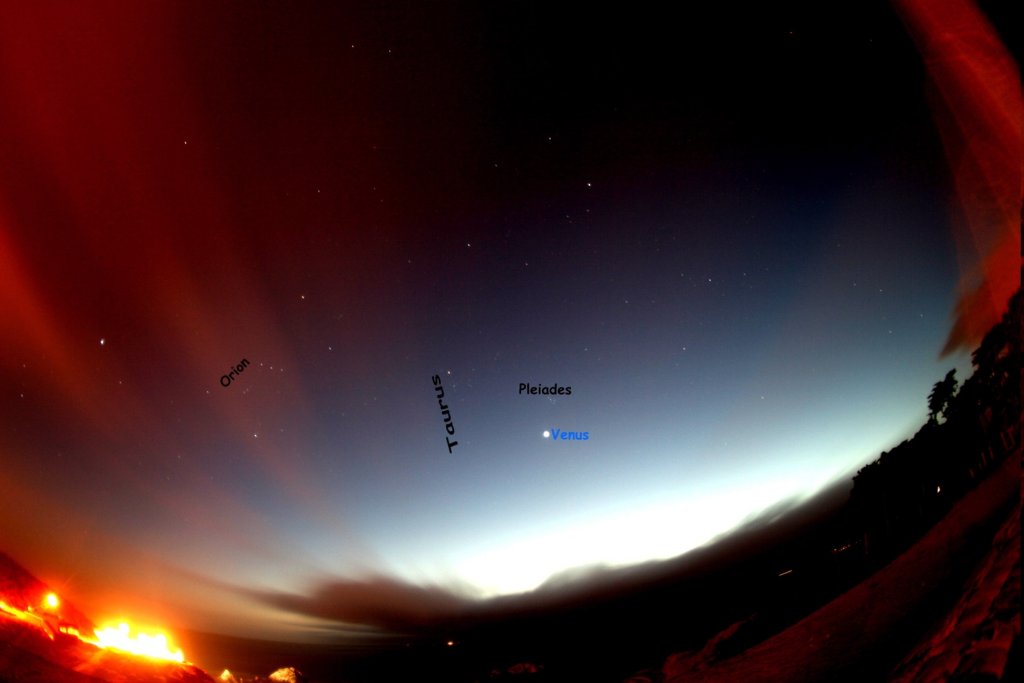
When the sun goes down tonight, step outside and look west. Brilliant Venus and the delicate Pleiades are almost side-by-side. Mohammad Taher Pilevar of Hamedan, Iran, took this picture just a few hours ago:

"On a cold windy night, the gathering of Venus and the Pleiades was a beautiful scene," he says.

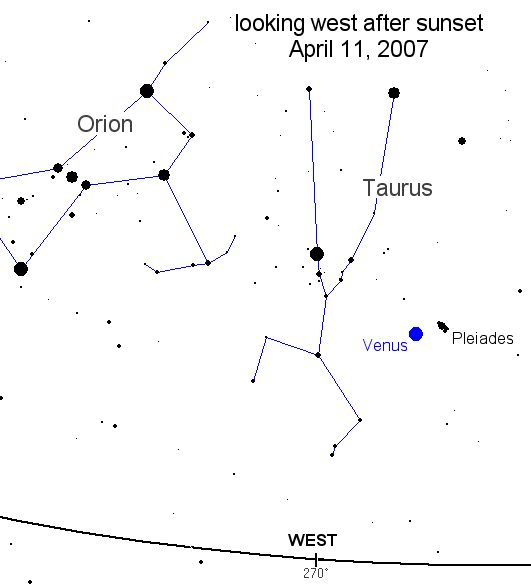
The view will improve in the nights ahead as the planet and the star cluster draw even closer together. They'll be at their best on Wednesday, April 11th, when only 2.5o degrees of arc lie between them, and you can eclipse the pair with the tip of your thumb held at arm's length. Don't miss it!

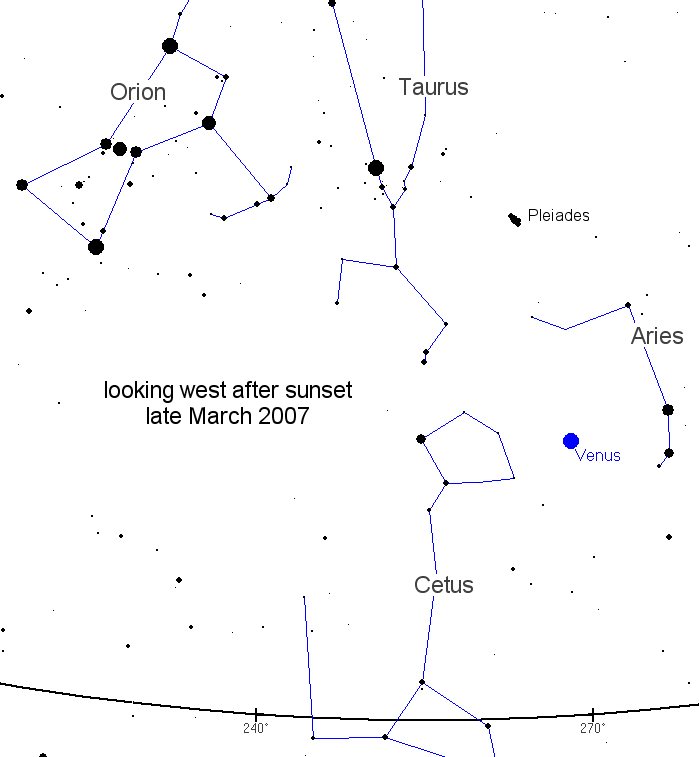
finder chart


more images: from Mila Zinkova of San Francisco, California

Source

sábado, 24 de marzo de 2007

Venus corona

Article from Spaceweather.com:

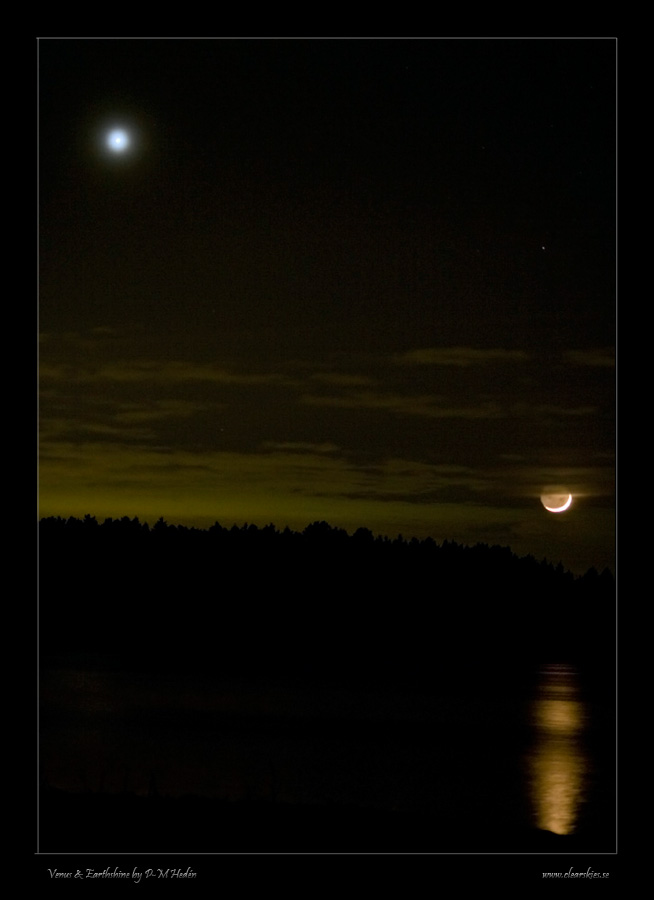
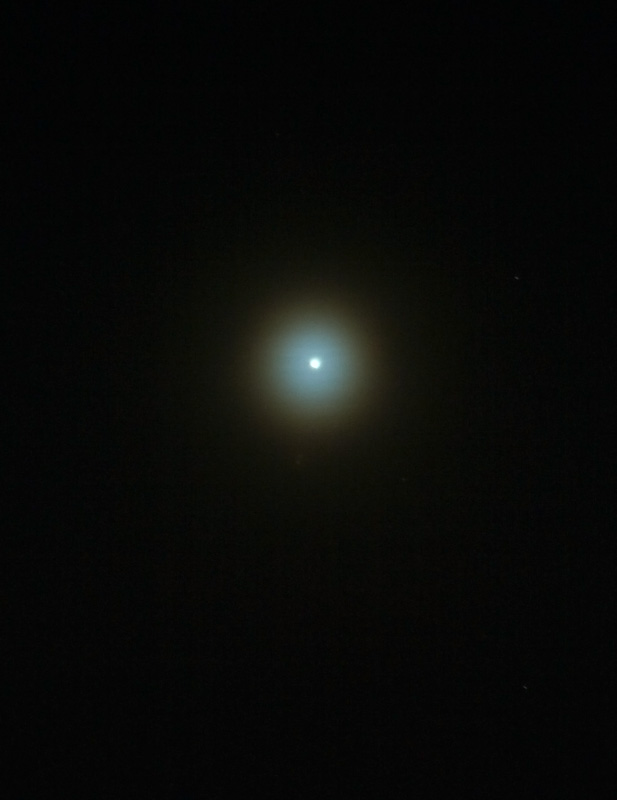
Venus is so bright, it does things usually reserved for the Sun and moon. For example, Venus makes coronas. Photographer P-M Hedén of Vallentuna, Sweden, photographed this one on March 20th:


"We can often see coronas around a bright moon," says atmospheric optics expert Les Cowley. "This is rarer. The circular patch with a straw-colored rim is an aureole, the centre of a corona produced by light from Venus scattered by tiny water drops in thin cloud or mist."

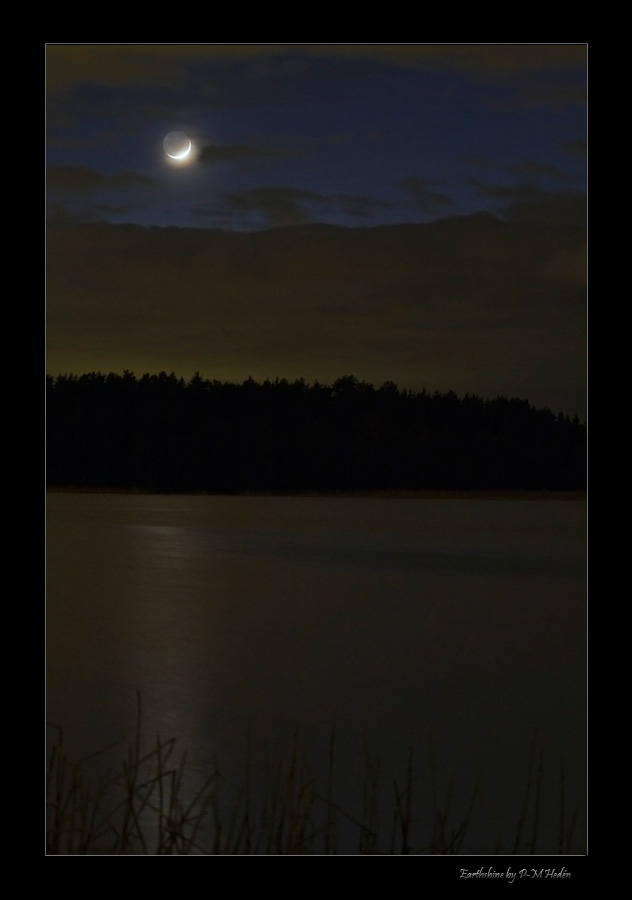
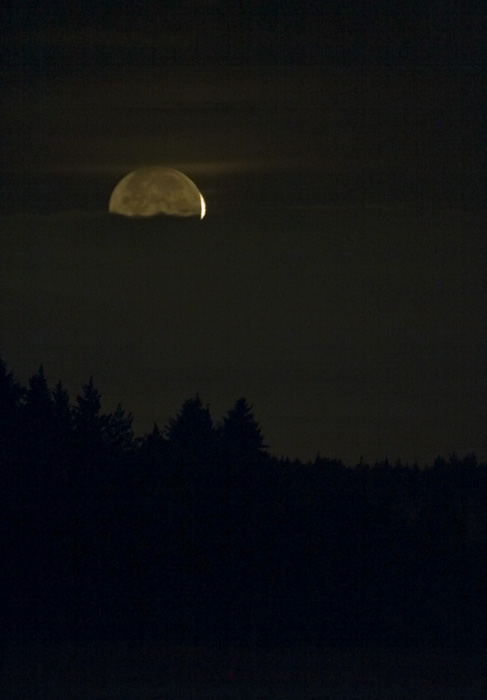
"I've never seen one like this before," adds Hedén. "The Venus halo together with a crescent moon setting over our lake felt almost unreal." Images: #1, #2, #3, #4.

Look for your own Venus coronas tonight. The planet materializes in the western sky at sunset bright enough to see even before the sky fades to black: finder chart.