Mostrando las entradas con la etiqueta Astrology. Mostrar todas las entradas

martes, 29 de enero de 2008

Mercury retrograde

For the astrology fans. Because this specific retrograde can be of help if u are aware of it:

From Astroprofile.com

Mercury is retrograde, appearing to move backward, 2-3 times a year. Mercury retrograde times call for you to recheck everything, anticipate and plan ahead, and to relearn lessons unlearned since the last Mercury retrograde cycle. It is a good time for review and completing ongoing projects. It is NOT a time to start something new. Mercury energies involve the mind, mental processes, communication, travel, speaking, and writing. The Retrograde symbol is "Rx", the same symbol on all medical prescriptions! Physicians until the 15th century had to also be astrologers before they could practice medicine. Plan ahead for these times. So you can do preventive maintenance and schedule, here are the common things that occur, the things Mercury retrograde times are notorious for:

  • Communications go awry - phone calls, letters, emails, faxes, conversations are delayed, misinterpreted, blocked. Recheck everything like appointment times, spelling, wording, the words you say.

  • Anticipate detours - memory lapses, confusion, failing to listen, failing to confirm, negotiation failures, changing of plans.

  • Avoid signing documents, contracts if possible. You can wait 3 weeks, hopefully.

  • Expect travel delays, car trouble, delayed plane schedules, reservations that suddenly becoming "missing", transportation difficulties of all kinds.

  • Expect problems with messages, books, letters, magazines, documents, neighbors and the near environment.

  • BACK up your computer files! This is the time the screen goes blank and there is nothing there!

  • Expect the phone lines, cable lines, power lines to have problems.

The Yellow shaded areas indicate dates when Mercury is retrograde. The "Red Letter" days are the most erratic, when Mercury is moving at its slowest, less than 1 degree each day. Plan even more carefully on "Red Letter Days".

The "gray shadow" areas are those called the "Shadow Period". The "gray shadow days" mark the beginning and ending of Mercury's influence. (Shadow begins when Mercury is at position where it will later turn Direct; Shadow ends when Mercury returns to position at which it went Retrograde.) The Retrograde cycle starts with warning Shadow days, intensity increases during the "Red Letter or Storm days" , things then move into the heightened chaos of the Mercury Retrograde, Mercury then slows and we have "Red Letter Days" at the end of the Retrograde, a final tapering off of Mercury effect during the closing Shadow Period cycle, and then Clear Days Ahead! "Red letter days" are those days during which Mercury moves VERY slowly and thus greater intensity is exhibited of those things ruled by Mercury. See other 2008 Retrograde planets also

2008 Retrograde Begins
Date & Time
Position at Start of Retrograde 2008 Retrograde Ends
Date & Time
Position at End
of Retrograde
January 28, 2008
3:31 pm EST
12:31 pm PST
23:49 Aquarius February 18, 2008
9:57 pm EST
6:57 pm PST
08:22 Aquarius
May 26, 2008
11:48 am EDT
8:48 am PDT
21:31 Gemini June 19, 2008
10:31 am EDT
7:31 am PDT
13:00 Gemini
September 24, 2008
3:17 am EDT
12:17 am PDT
22:50 Libra October 15, 2008
4:06 pm EDT
1:06 pm PDT
03:36 Libra

©1997-2008 AstroProfile.com. All Rights Reserved.

January 2008

S M T W T F S
1 2 3 4 5
6 7 9 9 10 11 12
13 14 15 16 17 18 19
20 21 22 23 24 25 26
27 28 29 30 31

February 2008

S M T W T F S
1 2
3 4 5 6 7 8 9
10 11 12 13 14 15 16
17 18 19 20 22 22 23
24 25 26 27 28 29

March 2008

S M T W T F S
1
2 3 4 5 6 7 8
9 10 11 12 13 14 15
16 17 18 19 20 21 22
23 24 25 26 27 28 29

April 2008

S M T W T F S
30 31 1 2 3 4 5
6 7 8 9 10 11 12
13 14 15 16 17 18 19
20 21 22 23 24 25 26
27 28 29 30

May 2008

S M T W T F S
1 2 3
4 5 6 7 8 9 10
11 12 13 14 15 16 17
18 19 20 21 22 23 24
25 26 27 28 29 30 31`

June 2008

S M T W T F S
1 2 3 4 5 6 7
8 9 10 11 12 13 14
15 16 17 18 19 20 21
22 23 24 25 26 27 28
29 30

July 2008

S M T W T F S
1 2 3 4 5
6 7 8 9 10 11 12
13 14 15 16 17 18 19
20 21 22 23 24 25 26
27 28 29 30 31

August 2008

S M T W T F S
1 2
3 4 5 6 7 8 9
10 11 12 13 14 15 16
17 18 19 20 21 22 23
24 25 26 27 28 29 30

September 2008

S M T W T F S
31 1 2 3 4 5 6
7 8 9 10 11 12 13
14 15 16 17 18 19 20
21 22 23 24 25 26 27
28 29 30

October 2008

S M T W T F S
1 2 3 4
5 6 7 8 9 10 11
12 13 14 15 16 17 18
19 20 21 22 23 24 25
26 27 28 29 30 31

November 2008

S M T W T F S
1
2 3 4 5 6 7 8
9 10 11 12 13 14 15
16 17 18 19 20 21 22
23 24 25 26 27 28 29

December 2008

S M T W T F S
30 1 2 3 4 5 6
7 8 9 10 11 12 13
14 15 16 17 18 19 20
21 22 23 24 25 26 27
28 29 30 31 1 2 3

lunes, 6 de agosto de 2007

See Several Shooting Star Shows

First of a few astronomy posts.

For Northern Hemisphere skywatchers, August is usually regarded as "meteor month," with one of the best displays of the year reaching its peak near mid-month. That display is, of course, the annual Perseid meteor shower beloved by everyone from meteor enthusiasts to summer campers.

This year experts predict an excellent Perseids display, as peak activity will coincide with a new moon, meaning dark skies that allow the meteors to shine.

Meanwhile, there are other lesser-known summer meteor displays to check out right now.

When to watch

In general, the Earth encounters richer meteoric activity during the second half of the year. And you're more likely to see twice as many meteors per hour in the predawn hours as compared to the evening hours. Here's why: During the pre-midnight hours we are on the trailing side of the Earth as it moves through space. Any meteoric particle generally must have an orbital velocity greater than that of the Earth to "catch" us. After midnight, when we have rotated onto the Earth's leading side, any particle that lies along the planet's orbital path will enter our atmosphere as a meteor.

In these head-on collisions, meteors hit our atmosphere at speeds of 7 to 45 miles per second. Their energy of motion rapidly dissipates in the form of heat, light, and ionization, creating short-lived streaks of light popularly referred to as "shooting stars."

Summertime meteors are especially noticeable between mid-July and the third week of August. And between Aug. 3 and 15, there are six different minor displays. When they run (and peak):

  • Southern Delta Aquarids, July 12-Aug. 19 (July 28), 15 per hour, faint, medium speed.
  • Alpha Capricornid, July 3-Aug. 15 (July 30), 4-5 per hour, slow, bright, a few fireballs.
  • Southern Iota Aquarids, July 25-Aug. 15 (Aug. 4), 1 to 2 per hour, faint, medium speed.
  • Northern Delta Aquarids, July 15-Aug. 25 (Aug. 8), 1 to 4 per hour, faint, medium speed.
  • Kappa Cygnids, Aug. 3-Aug. 25 (Aug. 18), 1 to 3 per hour, slow moving, sometimes brilliant.
  • Northern Iota Aquarids, Aug. 11-31 (Aug. 20), 1 to 3 per hour, faint, medium speed.
How to watch

The only equipment you'll need is your eyes and a modest amount of patience. Telescopes and binoculars are of no use for fast-moving meteors.

The actual number of meteors a single observer can see in an hour depends strongly on sky conditions. The rates above are based on a limited star magnitude of +6.5 (a really good sky), an experienced observer, and an assumption that the radiant is directly overhead. The radiant is the place in the sky where the paths of shower members, if extended backward, would intersect when plotted on a star chart.

Your clinched fist held at arm's length is equal to roughly 10-degrees on the sky. So if the radiant is 30-degrees ("three-fists") above the horizon, the hourly rate is halved; at 15-degrees it is a third.

While the hourly rates from these other meteor streams are but a fraction of the numbers produced by the Perseids, combined, overall they provide a wide variety of meteors of differing colors, speeds and trajectories.

The Southern Delta Aquarids, for example, can produce faint, medium speed meteors. The Alpha Capricornids generate slow, bright, long trailed yellowish meteors. And the Kappa Cygnids are classified as slow-moving and sometimes producing brilliant flaring fireballs.

Note that five of the six showers listed, come from the region around the constellations of Aquarius and Capricornus. These constellations are highest in the southern sky between roughly 1 and 3 a.m. local daylight time, so that's generally the best time to watch.

And don't forget to reserve the overnight hours of Aug. 12-13 for observing the Perseids, which under clear, dark skies will produce one or two meteors every minute.

miércoles, 25 de julio de 2007

Venus Retrograde

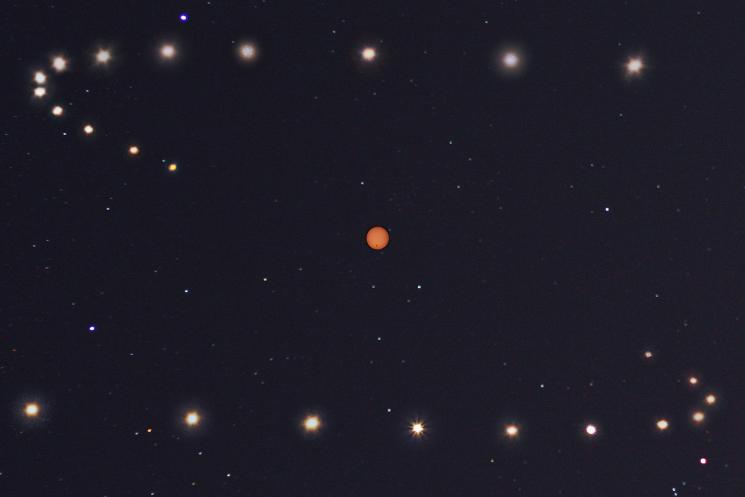
The phenomenon known as Venus Retrograde occurs approximately every 20 months when, for about forty days, Venus travels in reverse motion against the backdrop of stars. Of course, it doesn't really move backwards, but only appears to do so from our point of view here on Earth.

As Earth's closest planetary neighbor, Venus is the brightest planet in the sky. Visible in the western evening sky since December, she has become increasingly brighter since March.

Its motion slows until it appears to stand still on July 24 and then change direction. Continuing in its orbit, it disappears on August 13, then reappears as a morning "star" heralding the dawn on August 22. As Venus approaches its greatest elongation in the morning sky, it slows in its backward motion, stands still, then resumes its forward course on September 8, 2007, remaining visible as a morning star until May 10, 2008. The next Venus retrograde period begins in March 2009.

Mythical and astrological conjecture about the nature of the planet Venus has been prominent and consistent since ancient times. Her high visibility and her morning and evening phases have made her one of the most closely observed planets. Babylonian and Mesoamerican astrologers paid close attention to her cycles, particularly to her first appearance as a morning star, which was considered a dangerous time.

The Babylonians called Venus the double-phased Ishtar -- the morning star of war and the evening star of love. Greek astrologers called the morning phase of Venus Lucifer ("the light bearer") and the evening phase Hesperus ("setting in the West"). The Mesoamericans linked the morning phase of Venus with Quetzalcoatl, one of their major gods, believing that this was a time when leaders are struck down and natural disasters occur.

While Venus is retrograde, old friends and/or lovers may reenter one's life. During this period, financial returns are apt to be delayed and affection is more difficult to receive and express. Beginning a new relationship, buying luxury items and investing in objects of art or items of beauty is generally discouraged during the retrograde period.

Venus retrograde is a good time to reflect on your values, to review your relationships and to donate your energy to a charitable cause.

This Venus retrograde takes place mostly in the sign of Leo, promoting co-creativity, along with lavish and playful interactions. There is a yearning for attention that can leave you feeling unappreciated, even among your closest friends.

Love is highlighted with Venus in Leo, often leading to the formation of romantic relationships, with the retrograde they may end up offering more dramatic moments than playful ones. Loyalty and graciousness, easily degrades into possessive demands.

Be conscious of how you treat friends and loved ones. Your focused attitude may be perceived as selfish or prideful, and feelings could be hurt. This is an excellent time to review the amount of fulfillment derived from your recreational and romantic life and to consider how you can be more attentive and loving to others.