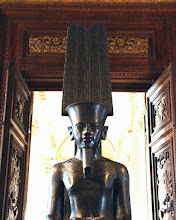
Sigh...
Maybe i should call this blog. Entre tres mundos. Add the flying.... Approach to Aeroparque Jorge Newbery. The second airport of Buenos Aires for domestic flights. Nice view over the city on approach from the South.

Maybe i should call this blog. Entre tres mundos. Add the flying.... Approach to Aeroparque Jorge Newbery. The second airport of Buenos Aires for domestic flights. Nice view over the city on approach from the South.
Halloween is date of astronomical interest. It has to do with seasons: Halloween is a cross-quarter date, approximately midway between an equinox and a solstice. There are four cross-quarter dates throughout the year, and each is a minor holiday: Groundhog Day (Feb. 2nd), May Day (May 1st), Lammas Day (Aug. 1st), and Halloween (Oct. 31st).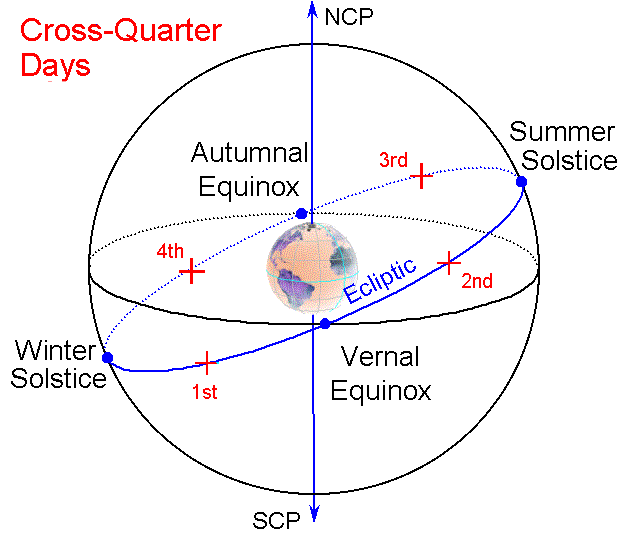 "Long ago, the Celts of the British Isles used cross-quarter days to mark the beginnings of seasons. Winter began with Halloween, or as they called it, Samhain," says John Mosley of the Griffith Observatory. "Halloween marked the transition between summer and winter, light and dark -- and life and death. On that one night, according to folklore, those who had died during the previous year returned for a final visit to their former homes. People set out food and lit fires to aid them on their journey -- but remained on guard for mischief the spirits might do."
And so something astronomical became something spooky. It's not the first time. Happy Halloween!
A 3-color image of the star-forming system HH 135-136, located 9,000 light-years away in the Carina nebula. The image is composed from three near-infrared images taken by the Anglo-Australian Telescope. Credit: Antonio Chrysostomou Invisible magnetic field lines twisted like long ropes of DNA help stars spiral into life, according to a new model.
New stars form from enormous clouds of gas and dust collapse under their own gravity into dense spheres. The packed cores are ignited by thermonuclear reactions. As they collapse, the clouds rotate, and like an ice skater pulling in his arms while spinning, rotation speed increases as the collapsing cloud gets smaller.
Some of this rotation energy, called angular momentum, must be dissipated before the star can contract completely. How this happens, though, is unknown.
"Given the size difference between an ordinary star like our sun and a typical molecular cloud, if the rotation was allowed to increase as the cloud collapsed, the [apparent] centrifugal forces would never allow the material to collapse into anything small enough to form a star," said study team member Antonio Chrysostomou at the University of Hertfordshire in the United Kingdom. "Hence, there needs to be a mechanism present which removes this angular momentum."
A new model by Chrysostomou and colleagues suggests excess material and energy are borne away from the protostar along helical magnetic field lines that surround the star. This stellar exodus carries away enough angular momentum to allow the spinning cloud to undergo the final phase of collapse necessary to become a star.
Their findings are detailed in the Nov. 1 issue of the journal Nature.
Our Milky Way is filled with magnetic fields, which are generated any time charged particles move about. The new model predicts that field lines around a cloudy stellar womb get twisted by the womb's rotation.
"The presence of ionized particles in the cloud will effectively drag the field around with it, thereby twisting it up," Chrysostomou told SPACE.com.
The team's new model is based on observations at the Anglo-Australian Observatory of the infrared light emitted by particles surrounding HH 135-136, a protostar cloaked in a molecular cloud located roughly 9,000 light-years away. They specifically examined which direction the particles faced.
"Interstellar grains become aligned to the magnetic field," Chrysostomou said. "They essentially behave as a Polaroid to radiation which passes through them. By measuring the degree of polarization we can deduce something about the magnetic field structure."
The team's new model predicts helical magnetic field lines around HH 135-136 extend some 50,000 AU from the protostar. One AU is equal to the distance between the Earth and the sun. Material is thought to be ejected from the system at more than 200,000 mph (100 kilometers per second).
Chrysostomou predicts that eventually the magnetic field lines will straighten out to become like the general galactic magnetic field. However, as observations of our sun show, magnetic field lines situated close to the star will remain a little curved.

 Archaeologists are finally grasping the true grandeur of the monument built 3,400 years ago by Pharaoh Amenhotep III
"Heya hup!" Deep in a muddy pit, a dozen workers wrestle with Egypt's fearsome lion goddess, struggling to raise her into the sunlight for the first time in more than 3,000 years. She is Sekhmet—"the one who is powerful"—the embodiment of the fiery eye of the sun god Ra, but now she is caked in dirt and bound by thick rope. As the workers heave her out of the pit and onto a wooden track, the sand shifts and the six-foot-tall granite statue threatens to topple. A half-dozen men in ankle-length robes grab the taut ropes, again shout the Arabic equivalent of "heave, ho!" and steady her just in time.
Within the hour, the seated Sekhmet is once again imperious: her breath creates the desert wind, her anger feeds on disease and war, and her power protects mighty pharaohs. Or did. This long-buried statue is one of 730—one for every day and night of the year—that guarded a vast collection of gates, colonnades, courts and halls built by the great Egyptian king Amenhotep III, who reigned over Egypt for 38 years in the 14th century B.C., at the height of peace and prosperity. In its day, "The House of Millions of Years" was the largest and most impressive temple complex in the world. But it was no match for earthquakes, fires, floods or Amenhotep III's successors, who scavenged stone blocks and statues for their own temples. Much of the site, near the Valley of the Kings along the west bank of the Nile River, is covered with sugar cane.
Hourig Sourouzian, an Armenian archaeologist, is directing the effort to rescue the long-neglected site and its many statues. "They didn't deserve this treatment!" she says as a worker hoses off the mud and salt coating a Sekhmet lined up with a dozen similar statues in the bright sun.
Egyptologists had long assumed that all that remained of the temple complex were the imposing Colossi of Memnon, two seated statues of Amenhotep III at the entrance to his temple, and some stones and fragments of statuary. Sourouzian had been working at a neighboring temple, Merentptah, from which she would visit the Amenhotep complex. "I was always interested in the fragmented statuary of the site and dreamed about seeing them reconstructed instead of lying in vegetation, water and junk," she recalls. Then, in 1996, a brush fire swept over the area, charring the stones and fragments and making them more vulnerable to cracking and erosion. When Sourouzian and her husband, German archaeologist Rainier Stadelmann, surveyed the damage, she says, "It was terrible and depressing, and we swore to take action."
First, she convinced the World Monuments Fund in 1998 to designate the temple one of the world's "100 Most Endangered Sites" and fund the initial conservation area of the shattered fragments aboveground. During the course of that effort, Sourouzian began to suspect that there was more to be found underground. By 2000, however, the money had run out, and she and Stadelmann reluctantly began to wrap up their work. But a wealthy French woman who had attended a lecture by Sourouzian in Paris agreed to fund a more ambitious excavation. Within a year, the team began to uncover their first statues, and the archaeologists realized that many treasures still lay beneath the dirt.
Born in Baghdad to parents of Armenian descent, Sourouzian grew up in Beirut and studied art history at the Sorbonne in Paris. Sent to Karnak by the Louvre, she became one of the leading authorities on Egyptian royal statuary. "She's probably the best Egyptian art historian of our time," says Betsy Bryan, an Egyptologist at Johns Hopkins University. Now, along with Stadelmann, who once headed the German Archaeological Institute in Cairo, Sourouzian orchestrates a team of two dozen specialists from around the world—including French, Swiss, German, Spanish and Japanese researchers—and as many as 400 local workers.
What began modestly has become one of the most ambitious projects Egypt has seen in decades, bringing to light a triumph of engineering and art that once dwarfed even the massive Karnak and Luxor temples across the Nile. Amenhotep III called the complex "a fortress of eternity out of good white sandstone—worked with gold throughout. Its floors were purified with silver, all of its doorways were of electrum," an alloy of gold and silver.
The recently liberated Sekhmet statue is one of 72 of the goddess that Sourouzian and her team have discovered. They've also found two huge statues of Amenhotep III, each flanked by a smaller one of Queen Tye and a menagerie of sacred animals, including an alabaster hippopotamus. The project is giving Egyptologists a fresh look at the mysterious temple culture that dominated ancient life here, in which hordes of priests conducted rituals, made offerings and administered the intricate rites designed to ensure the eternal well-being of the dead pharaoh.
Once brightly painted in blues, reds, greens, yellows and whites, the 50-foot colossi in front of the massive first gate, or pylon, loomed over the Nile Valley's flat farmland, facing the brown river that then flowed just a few hundred yards away. While the rest of the complex collapsed and crumbled, the stately statues remained. Cracks caused by an earthquake in 27 B.C. made one of the statues produce an odd tone when the morning sun struck it. A contemporary named Pausanias described the sound in his Guide to Greece as "very like the twang of a broken lyre-string or a broken harp-string." The site quickly became one of the ancient world's biggest tourist attractions; even the Roman emperor Hadrian came to hear it in A.D. 130. Alas, it was inadvertently silenced during restoration work in A.D. 199.
On a hot morning, visiting American archaeologists and art conservators spill out of a crowded van. Sourouzian leads them into a storeroom the length of a railroad car, and the visitors marvel at the Sekhmets, a giant head of the pharaoh, and bits and pieces of unidentified faces in neat rows—fresh finds from Sourouzian's team. "She's Isis reassembling Osiris," says the University of Chicago archaeologist Ray Johnson, of Sourouzian, likening her to the goddess who recovers dismembered pieces of her lover and restores him to life.
Few building sprees in history can match that of Amenhotep III, and few pharaohs' lives are so well documented—even his birth is commemorated in stone reliefs at Luxor. He came to the throne before his teens, at the death of his warrior father Thutmose IV. His grandfather and father had expelled Mesopotamian invaders known as the Mitanni. The young pharaoh quelled an uprising in Nubia at the southern fringe of his empire—chopping off the right hands of 312 enemies—but turned to diplomacy for the rest of his reign.
His principal wife, Tye, was from a noble Egyptian family, but Amenhotep III's harem grew to include princesses from great powers such as Babylon and Mitanni—a common method of cementing alliances in the ancient world, but unusual for Egypt, whose rulers tended to disdain foreigners. He also maintained regular correspondence with other kings. Letters written in Mesopotamian cuneiform found at Amarna, the capital built by his son Akhenaten, reveal a canny leader who preferred words to weapons.
The peace that Amenhotep III worked hard to preserve brought a boom in international trade, with partners from throughout the Mediterranean, across Western Asia and deep into Africa—thanks in part to Egypt's many gold mines. "Gold in your country is dirt; one simply gathers it up," wrote an obviously envious Assyrian king. The pharaoh used his wealth to transform the nation into an imperial showplace. He ordered temples built from the Nile Delta in the north to Nubia 800 miles to the south. Under his patronage, artists experimented with new styles of sculpture and reliefs carved into temple walls. Traditional rudimentary forms became elegant and sophisticated, and the carvings reveal more attention to craft and detail. It was "probably the highest-quality art Egypt ever made," says Johns Hopkins' Betsy Bryan. "The man had taste!"
Amenhotep III reserved the greatest works for his hometown, Thebes, today's Luxor. During most of the so-called New Kingdom, which lasted from 1570 B.C. to 1070 B.C., pharaohs resided at Memphis, a cosmopolitan city near today's Cairo. But as Amenhotep III grew older, he spent more and more time in Thebes, turning it into one vast religious center spanning both sides of the Nile. Large additions were made to the Karnak and Luxor temples on the Nile's east bank, both of which had begun as small Middle Kingdom sanctuaries. Across the river, Amenhotep III built a huge harbor and an adjacent palace with colorfully painted walls, as well as his extensive funerary temple.
It was this great temple, rather than his hidden tomb in the Valley of the Kings, that Amenhotep III counted on to ensure his soul's journey to the afterlife—and, no doubt, inspire awe among the living. Stretching seven football fields in length from the colossi at the main entrance, which faced east to the Nile, to sacred altars pointing toward the Valley of the Kings in the west, the complex covered an area nearly the size of Vatican City. In its day, it was the largest and one of the most ornate religious structures in the world, filled with hundreds of statues, stone reliefs and inscriptions set among colonnaded plazas. Colorful royal banners flapped from cedar poles shimmering in gold leaf and secured on red granite pedestals at pylons, or massive gateways, that led into innumerable sanctuaries.
Such an awesome sight is hard to envision today. In addition to an earthquake a century or so after Amenhotep III's death that toppled its columns and walls, successive pharaohs raided it for their own temples. Ramses II took two seated colossi in the 13th century B.C., and the site was still being scavenged a thousand years later. The earthquake in 27 B.C. toppled much of what remained. Nineteenth-century treasure hunters carted off what they could find from the rubble—sphinxes to embellish the Neva River embankment in St. Petersburg, royal statues to London's British Museum and a head of the pharaoh to the Louvre in Paris. Excavations from the 1950s through the 1970s revealed little more than scattered stone fragments and artifacts.
Today's most insidious threat is the slow rising of groundwater. In the past, the Nile flooded annually, replenishing fields along the river before retreating to within its banks. (Some scholars, though not Sourouzian, believe Amenhotep III's temple was designed to allow the holy Nile floodwaters to wash through the gates and plazas.) Since the Aswan High Dam was completed in 1970, the Nile waters no longer surge over its banks (and the river is two miles from the temple site), but sugar cane farmers irrigate year-round, turning the desert into soggy soil. The water carries salts that eat away at stone, particularly more porous varieties such as limestone and sandstone.
On a spring morning, the huge field, bordered by sugar cane and the road to the Valley of the Kings, resembles a busy construction site. At the spot where a pylon once stood behind the Colossi of Memnon, researchers sit under tarps, patiently sorting and photographing fragments from one of two smaller colossi that fell in antiquity. The head of one of them alone weighs 25 tons, and nearly 200 workers and a winch were required to pull the broken statue out of the mud. Sourouzian hopes to re-erect those statues—each torso weighs 450 tons—once the ground dries and a secure foundation can be built.
Nearby, an alabaster statue of a crocodile and two more statues of Amenhotep III, also in alabaster, wait to be cleaned. Remains of massive sandstone columns are in rows of three and four. The columns formed the edges of the great peristyle hall, or sun court, and once stood on crude blocks and gravel. "Obviously, they were cutting corners here and there," says Theodore Gayer-Anderson, a British archaeologist on the team. "They weren't the ideal builders." The stubs of the columns are fragile, and to coax out salt, which is corrosive, Gayer-Anderson coats them in a poultice of deionized water, cellulose powder and mineral powder. Each wrapping must be changed every two days. "It's impossible to eliminate the salt," he says. "But you can cleanse the skin to a stable level."
A few yards away, a seven-ton torso of Amenhotep III dangles below an iron tepee, as workers prepare to marry it to a base covered in protective scaffolding. The statue's head was found a century ago and is now in the British Museum. The museum has promised to send a cast of the head to be placed on the torso next spring. An Egyptian foreman barks at the workers as the torso is raised into place, while a Spanish archaeologist paces across some beams. "I'm not nervous—that wouldn't help," he announces.
This is the first of five 25-foot-high statues of Amenhotep III that the team intends to re-erect. The statues once stood between the columns. On the north side of the peristyle hall, the statues are made from quartzite from near today's Cairo and they wear the chair-shaped crown of lower Egypt (that is, northern Egypt, which lies downstream along the Nile). On the south side, the images are made from Aswan's red granite and wear the white conical headpiece of upper Egypt. In addition to the statues of the pharaoh, which were in fragments, an alabaster hippopotamus surfaced, minus head and tail, along with six standing statues of Sekhmet, beautifully preserved, each holding a papyrus bundle in one hand and an ankh—the symbol of life—in the other.
The excavation is only in its initial phases and could take two decades or more. To the west of the peristyle hall was a hypostyle hall, a vast interior space that once had a roof supported by massive columns. It no doubt holds more statues and artifacts. "You would need years and millions of dollars to excavate," says Sourouzian, looking with a touch of longing over the bare ground. "What's more urgent is to save the statues, preserve the last remains of the temple and present it with dignity."
 Argentina's president-elect Cristina Kirchner has said her victory in Sunday's election was a recognition of her husband's success as president.
She told Argentine TV her priorities included tackling poverty and pushing for further Latin American integration, especially in energy issues.
Mrs Kirchner also wished US Sen Hillary Clinton, to whom she has been compared, well in her own presidential campaign.
Mrs Kirchner is due to take over from husband Nestor Kirchner on 10 December.
Mrs Kirchner, who rarely gave interviews during the campaign, spoke to Argentina's Todo Noticias network on Monday, hours after her election victory.
She won nearly 45% of the vote, ahead of her nearest rival, former lawmaker Elisa Carrio, on 23%.
Mrs Kirchner acknowledged that her husband, who oversaw Argentina's recovery from the economic crisis of 2001, had played a major role in her win.
"[Mr] Kirchner has been the flagship of this project as the president of all Argentines. It's very important what President Kirchner has achieved in four-and-a-half years in office and this triumph is part of that."
Mrs Kirchner was also quick to defend her husband's handling of inflation, which is officially put at a little under 9% a year but which is unofficially thought to be as high as 20%.
Among her priorities, she said, would be tackling unemployment and poverty, and working to improve health care and education.
Woman power
She also said it was important to strengthen the regional trade bloc, Mercosur, which groups Argentina with Brazil, Paraguay and Uruguay, and which has invited oil-rich Venezuela to join.
Mrs Kirchner would not be drawn on what Mr Kirchner will do once he is out of office.
"He's going to do what he has always done. He's a political animal. He's a man who deeply loves politics and really loves his country and has a great commitment to Argentina," she said.
There has been speculation that Mr Kirchner may return to run in the 2011 election.
During the interview, Mrs Kirchner said she was happy to be compared to US Democratic presidential hopeful Hillary Clinton, both law graduates, senators and former first ladies.
"Everything seems to indicate that she is the favourite of the Americans," said Mrs Kirchner, Argentina's first elected female president.
"And why not? Another woman wouldn't be bad."
 A promontory nicknamed "Cape Verde" can be seen jutting out from the walls of Victoria Crater in this approximate true-color picture taken by the panoramic camera on NASA's Mars Exploration Rover Opportunity. The rover took this picture on martian day, or sol, 1329 (Oct. 20, 2007), more than a month after it began descending down the crater walls – and just 9 sols shy of its second Martian birthday on sol 1338 (Oct. 29, 2007). Opportunity landed on the Red Planet on Jan. 25, 2004. That's nearly four years ago on Earth, but only two on Mars because Mars takes longer to travel around the sun than Earth. One Martian year equals 687 Earth days.
The overall soft quality of the image, and the "haze" seen in the lower right portion, are the result of scattered light from dust on the front sapphire window of the rover's camera.
This view was taken using three panoramic-camera filters, admitting light with wavelengths centered at 750 nanometers (near infrared), 530 nanometers (green) and 430 nanometers (violet).
Image Credit: NASA/JPL-Caltech/Cornell
In this artist's portrayal of the IC 10 X-1 system, the black hole lies at the upper left and its companion star is on the right. The two objects orbit around a center of gravity once every 34.4 hours. The stellar companion is a type known as a Wolf-Rayet star. Such stars are highly evolved and destined to explode as supernovae. The black hole companion is shedding its outer envelope in a powerful wind, and some of this gas is captured by the black hole's powerful gravity. Credit: Aurore Simonnet/Sonoma State University/NASA The heaviest "small" black hole ever has been discovered, and its mass of 24 to 33 times that of our sun defies current theories to explain its formation, scientists say.
The new record setter, announced by NASA today, shatters an already puzzling weight record set earlier this month.
Black holes trap all matter and light entering them and can't be seen directly, so scientists detect them by noting their gravitational effects on other objects or by the radiation emit.
The newfound object belongs to a class of black holes formed during the final death throes of massive stars. These "stellar" black holes are generally around 10 solar masses.
"We weren't expecting to find a stellar-mass black hole this massive," said study team member Andrea Prestwich of the Harvard-Smithsonian Center for Astrophysics in Cambridge. "It seems likely that black holes that form from dying stars can be much larger than we had realized."
The new black hole, detailed in the Nov. 1 issue of Astrophysical Journal Letters, is located in the nearby dwarf galaxy IC 10, 1.8 million light-years from Earth in the constellation Cassiopeia.
As large as it is, the new stellar black hole is still tiny compared to "supermassive" black holes, which are thought to lie at the heart of many galaxies and can have masses of million to billions times that of our sun.
New record holder
The previous record holder for largest stellar-mass black hole was a 16-solar-mass black hole in the galaxy M33 announced just two weeks ago.
As with that case, scientists were able to calculate the new black hole's mass because it is in a rare alignment with its companion star. Viewed from Earth, the star periodically passes directly in front of the black hole, blocking its X-rays. The periodic changes in the black hole's X-ray brightness were detected in Nov. 2006 by NASA's Chandra X-ray Observatory. Follow-up observations by NASA's Swift satellite and the Gemini Telescope in Hawaii confirmed the eclipses and revealed details about the star's orbit.
Using this information, Prestwich's team calculated how fast the two objects were orbiting each other and their masses.
The team pegs the black hole's mass at 24 suns at minimum, but there are still some uncertainties in the estimate. "Future optical observations will provide a final check," Prestwich said. "Any refinements in the IC 10 X-1 measurement are likely to increase the black hole's mass rather than reduce it."
Anemic black holes
Scientists estimate that the host star from which the black hole formed had a mass of about 60 or more solar masses. Most stars shed most of their mass when they explode as supernovas prior to becoming black holes. The host star was likely deficient in elements heavier than hydrogen and helium, scientists speculate, which are more prone to being swept away by stellar winds.
"Massive stars in our galaxy today are probably not producing very heavy stellar-mass black holes like this one," said study team member Roy Kilgard of Wesleyan University in Middletown, Conn. "But there could be millions of heavy stellar-mass black holes lurking out there that were produced early in the Milky Way's history, before it had a chance to build up heavy elements."
The faint tail of Comet Holmes detected in near-infrared Oct. 26, 2007. Credit: University of Montreal, Mont Megantic Observatory A comet that has engaged skywatchers worldwide with its sudden outburt has had one disappointing aspect: no tail.
Comet Holmes brightened suddenly and dramatically last week, going from total obscurity to naked-eye brightness that rivaled some of the brighter stars in the sky. But without a tail, the gas and dust ejected by the comet left it looking like no more than a fuzzy tennis ball through backyard telescopes.
Now astronomers think they've found a hint of a tail. Don't expect to see it for yourself, however.
A new image made using near-infrared light, which humans can't see, shows a small, tail-like feature next to the comet's nucleus. The image was obtained by graduate student Sandie Bouchard and assistant Bernard Malenfant on the pre-dawn hours of Oct. 26 using the Ritchey-Chretien telescope at Mont Megantic Observatory in Canada.
A preliminary analysis, performed by astronomers Pierre Bastien and Rene Doyon from University of Montreal and the Centre de Recherche en Astrophysique du Quebec (CRAQ) clearly shows a bright elongated feature.
However, the direction of the feature does not point directly away from the sun, as expected. Comet tails are formed when pressure from sunlight pushes inexorably on the material in the head, which surrounds the solid nucleus. This material—gas, dust, and ice particles—is typically pushed away from the sun to form the tail.
Astronomers don't know why the outburst occurred. Comet Holmes has been known for more than a century but has been quiet for decades, visible only through powerful telescopes.
 Argentine first lady Cristina Fernandez de Kirchner declared victory Sunday night as election returns showed her leading all rivals in her bid to succeed her husband and become the country's first female president.
Thousands of supporters lined up outside the Buenos Aires hotel where she delivered her victory speech, banging drums, waving flags and chanting, "Cristina, Cristina."
Fernandez de Kirchner called her victory "a triumph for all Argentines" and thanked supporters for entrusting her with the "major responsibility" of the presidency.
She also thanked her husband, center-left President Nestor Kirchner, who is expected to switch roles and become the leading adviser to his wife once she takes office.
Fernandez de Kirchner has been a top adviser to her husband during his four years in office and serves in the country's Senate. During the campaign, she promised to continue his economic policies, which she credited with reviving the country's economy after the country's 2001-2002 financial meltdown.
With just over two-thirds of polling places reporting, Fernandez had about 43 percent of the vote, compared with 23 percent for former lawmaker Elisa Carrio and 18 percent for former Economy Minister Roberto Lavagna, The Associated Press reported. Eleven others split the rest.
Six independent television networks, a private radio station and an opposition newspaper reported their exit polling indicated Fernandez has easily won a first-round victory.
But no opposition candidates conceded defeat, and Carrio spokesman Matias Mendez said seven parties had filed a complaint alleging that ballots were missing or stolen in Buenos Aires province, the country's most populous.
Electoral officials denied any irregularities, but a judge extended voting by an hour in the capital after many of Argentina's 12,700 polling stations opened late. A representative of the ruling party was arrested on suspicion of trying to vote twice.
The Kirchners have drawn comparisons to former U.S. President Bill Clinton and his wife, Sen. Hillary Clinton, now the Democratic presidential front-runner in the 2008 U.S. elections.
The next president, who begins a four-year term on December 10, faces challenges including high inflation, an energy shortage and rampant crime in a country that a century ago ranked among the world's 10 richest.
Fernandez de Kirchner, 54, refused to debate and spent much of the campaign abroad in photo-ops with world leaders. Her chic European dresses and designer bags also drew comparisons with "Evita" Peron.
Fernandez de Kirchner will be the first woman elected to the Casa Rosada, though Argentina has been led by a woman once before. Isabel Peron, the wife of longtime leader Juan Peron, took office after her husband's 1974 death and ruled until she was overthrown in 1976.
Fernandez de Kirchner, who built her own independent career as her husband rose to power, has rejected comparisons to both Clinton and Evita.
She told the crowd of reporters that voting was especially joyful for her because she grew up under the 1976-83 dictatorship, according to a report from The Associated Press.
"I'm part of a generation that grew up in a country in which nobody could say anything, so we value this in a very special way," she said.
Voters were also filling dozens of House and Senate seats and nine governorships. Exit polls indicated Vice President Daniel Scioli won the governorship of Buenos Aires province, the country's second most powerful post.
Argentina's 27.1 million registered voters are required by law to cast ballots.
Video:


This image, taken with Spitzer's infrared vision, shows a fraction of these black holes, which are located deep in the bellies of distant, massive galaxies (circled in blue). Image credit: NASA/JPL-Caltech/ Commissariat a l'Energie Atomique Astronomers have unmasked hundreds of black holes hiding deep inside dusty galaxies billions of light-years away.
The massive, growing black holes, discovered by NASA's Spitzer and Chandra space telescopes, represent a large fraction of a long-sought missing population. Their discovery implies there were hundreds of millions of additional black holes growing in our young universe, more than doubling the total amount known at that distance.
"Active, supermassive black holes were everywhere in the early universe," said Mark Dickinson of the National Optical Astronomy Observatory in Tucson, Ariz. "We had seen the tip of the iceberg before in our search for these objects. Now, we can see the iceberg itself." Dickinson is a co-author of two new papers appearing in the Nov. 10 issue of the Astrophysical Journal. Emanuele Daddi of the Commissariat a l'Energie Atomique in France led the research.
The findings are also the first direct evidence that most, if not all, massive galaxies in the distant universe spent their youths building monstrous black holes at their cores.
For decades, a large population of active black holes has been considered missing. These highly energetic structures belong to a class of black holes called quasars. A quasar consists of a doughnut-shaped cloud of gas and dust that surrounds and feeds a budding supermassive black hole. As the gas and dust are devoured by the black hole, they heat up and shoot out X-rays. Those X-rays can be detected as a general glow in space, but often the quasars themselves can't be seen directly because dust and gas blocks them from our view.
"We knew from other studies from about 30 years ago that there must be more quasars in the universe, but we didn't know where to find them until now," said Daddi.
Daddi and his team initially set out to study 1,000 dusty, massive galaxies that are busy making stars and were thought to lack quasars. The galaxies are about the same mass as our own spiral Milky Way galaxy, but irregular in shape. At 9 to 11 billion light-years away, they existed at a time when the universe was in its adolescence, between 2.5 and 4.5 billion years old.
When the astronomers peered more closely at the galaxies with Spitzer's infrared eyes, they noticed that about 200 of the galaxies gave off an unusual amount of infrared light. X-ray data from Chandra, and a technique called "stacking," revealed the galaxies were, in fact, hiding plump quasars inside. The scientists now think that the quasars heat the dust in their surrounding doughnut clouds, releasing the excess infrared light.
"We found most of the population of hidden quasars in the early universe," said Daddi. Previously, only the rarest and most energetic of these hidden black holes had been seen at this early epoch.
The newfound quasars are helping answer fundamental questions about how massive galaxies evolve. For instance, astronomers have learned that most massive galaxies steadily build up their stars and black holes simultaneously until they get too big and their black holes suppress star formation.
The observations also suggest that collisions between galaxies might not play as large a role in galaxy evolution as previously believed. "Theorists thought that mergers between galaxies were required to initiate this quasar activity, but we now see that quasars can be active in unharassed galaxies," said co-author David Alexander of Durham University, United Kingdom.
"It's as if we were blindfolded studying the elephant before, and we weren't sure what kind of animal we had," added co-author David Elbaz of the Commissariat a l'Energie Atomique. "Now, we can see the elephant for the first time."
The new observations were made as part of the Great Observatories Origins Deep Survey, the most sensitive survey to date of the distant universe at multiple wavelengths.
Consistent results were recently obtained by Fabrizio Fiore of the Osservatorio Astronomico di Roma, Italy, and his team. Their results will appear in the Jan. 1, 2008, issue of Astrophysical Journal.
NASA's Marshall Space Flight Center, Huntsville, Ala., manages the Chandra program for the agency's Science Mission Directorate. The Smithsonian Astrophysical Observatory controls science and flight operations from the Chandra X-ray Center in Cambridge, Mass. NASA's Jet Propulsion Laboratory, Pasadena, Calif., manages the Spitzer Space Telescope mission for NASA's Science Mission Directorate, Washington. Science operations are conducted at the Spitzer Science Center at the California Institute of Technology, also in Pasadena. Caltech manages JPL for NASA.
The National Optical Astronomy Observatory is operated by the Association of Universities for Research in Astronomy under a cooperative agreement with the National Science Foundation.
An image of the bullet cluster taken by NASA's Chandra X-ray telescope. Scientists claimed the image was proof of normal matter (pink) being separated from dark matter (blue). Another group now says the observations can be explained by a modified gravity of theory, and that dark matter is unnecessary. Credit: X-ray: NASA/CXC/CfA/M.Markevitch et al.; Optical: NASA/STScI; Magellan/U.Arizona/D.Clowe et al.; Lensing Map: NASA/STScI; ESO WFI; Magellan/U.Arizona/D.Clowe et al.  Two Canadian astronomers think there is a good reason dark matter, a mysterious substance thought to make up the bulk of matter in the universe, has never been directly detected: It doesn't exist.
Dark matter was invoked to explain how galaxies stick together. The visible matter alone in galaxies—stars, gas and dust—is nowhere near enough to hold them together, so scientists reasoned there must be something invisible that exerts gravity and is central to all galaxies.
Last August, an astronomer at the University of Arizona at Tucson and his colleagues reported that a collision between two huge clusters of galaxies 3 billion light-years away, known as the Bullet Cluster, had caused clouds of dark matter to separate from normal matter. Many scientists said the observations were proof of dark matter's existence and a serious blow for alternative explanations aiming to do away with dark matter with modified theories of gravity.
Now John Moffat, an astronomer at the University of Waterloo in Canada, and Joel Brownstein, his graduate student, say those announcements were premature.
In a study detailed in the Nov. 21 issue of the Monthly Notices of the Royal Astronomical Society, the pair says their Modified Gravity (MOG) theory can explain the Bullet Cluster observation. MOG differs from other modified gravity theories in its details, but is similar in that it predict that the force of gravity changes with distance.
"MOG gravity is stronger if you go out from the center of the galaxy than it is in Newtonian gravity," Moffat explained. "The stronger gravity mimics what dark matter does. With dark matter, you take Einstein and Newtonian gravity and you shovel in more dark matter. If there's more matter, you get more gravity. Whereas for me, I say dark matter doesn't exist. It's the gravity that's changed."
Using images of the Bullet Cluster made by the Hubble, Chandra X-ray and Spitzer space telescopes and the Magellan telescope in Chile, the scientists analyzed the way the cluster's gravity bent light from a background galaxy—an effect known as gravity lensing. The pair concluded that dark matter was not necessary to explain the results.
"Using Modified Gravity theory, the 'normal' matter in the Bullet Cluster is enough to account for the observed gravitational lensing effect," Brownstein said. "Continuing the search for and then analyzing other merging clusters of galaxies will help us decide whether dark matter or MOG theory offers the best explanation for the large scale structure of the universe."
Moffat compares the modern interest with dark matter to the insistence by scientists in the early 20th century on the existence of a "luminiferous ether," a hypothetical substance thought to fill the universe and through which light waves were thought to propagate.
"They saw a glimpse of special relativity, but they weren't willing to give up the ether," Moffat told SPACE.com. "Then Einstein came along and said we don't need the ether. The rest was history."
Douglas Clowe, the lead astronomer of the team that linked the Bullet Cluster observations with dark matter (and now at Ohio University), says he still stands by his original claim. For him and many other astronomers, conjuring up new particles that might account for dark matter is more palatable than turning a fundamental theory of how the univese works on its head.
"As far as we're concerned, [Moffat] hasn't done anything that makes us retract our earlier statement that the Bullet Cluster shows us that we have to have dark matter," Clowe said. "We're still open to modifying gravity to reduce the amount of dark matter, but we're pretty sure that you have to have most of the mass of the universe still in some form of dark matter."
From last Wednesdays CSI NY Episode 4x05 Down The Rabbit Hole. This is a battle scene from that episode. The episode was aired also live in Second Life itself. Missed that one!
Got hooked yet? hehe
DST is now OFF for a lot of countries in Europe. Argentina has no changes of such and therefore the difference between CET and Buenos Aires time is now +4. See also the clocks on the right. They should have the correct time.
 An image of what i think is Luxor temple in Luxor Egypt. The camera was not held still obviously, giving this interesting effect.

 These are from Luxor, Egypt as well. First one is the goddess Mut from the Luxor museum. Mut is known as consort of the god Amun. She has her own precinct in the temple of Karnak basically "next to" Luxor. The other one is from the temple of Hatshepsut at Deir-el-Bahri, Luxor on the other side of the Nile. This is a representation of the goddess Hathor (Hethert) in her chapel of the mentioned temple.

 2 Images of a line of sphynxes in Luxor Egypt. First in dark and then as most see it, in daylight.
An artist's representation of M33 X-7: a binary system in the nearby galaxy M33, containing a massive blue star feeding material to a black hole surrounded by a small accretion disk. Credit: NASA/CXC/M. Weiss A stellar black hole much more massive than theory predicts is possible has astronomers puzzled.
Stellar black holes form when stars with masses around 20 times that of the sun collapse under the weight of their own gravity at the ends of their lives. Most stellar black holes weigh in at around 10 solar masses when the smoke blows away, and computer models of star evolution have difficulty producing black holes more massive than this.
The newly weighed black hole is 16 solar masses. It orbits a companion star in the spiral galaxy Messier 33, located 2.7 million light-years from Earth. Together they make up the system known as M33 X-7.
"We're having trouble using standard theories to explain this system because it is so massive," study team member Jerome Orosz of the University of California, San Diego, told SPACE.com.
The black hole in M33 X-7 is also the most distant stellar black hole ever observed. The findings, detailed in the Oct. 17 issue of the journal Nature, could help improve formation models of "binary" systems containing a black hole and a star. It could also help explain one of the brightest star explosions ever observed.
Black hole eclipse
Black holes can't be seen, because all matter and light that enters them is trapped. So black holes are detected by noting their gravitational effects on nearby stars or on material that swirls around them.
The companion star of M33 X-7 passes directly in front of the black hole as seen from Earth once every three days, completely eclipsing its X-ray emissions. It is the only known binary system in which this occurs, and it was this unusual arrangement that allowed astronomers to calculate the pair's masses very precisely.
The tight orbits of the black hole and star suggests the system underwent a violent stage of star evolution called the common-envelope phase, in which a dying star swells so much it sucks the companion inside its gas envelope.
This results in either a merger between the two stars or the formation of a tight binary in which one star is stripped of its outer layers. The team thinks the latter scenario happened in the case of M33 X-7, and that the stripped star explodes as a supernova before imploding to form a black hole.
However, something unusual must have happened to M33 X-7 during this phase to create such a massive black hole. "The black hole must have lost a large amount of mass for the two objects to be so close," Tomasz Bulik, an astronomer at the University of Warsaw in Poland, writes in related Nature article. "But on the other hand, it must have retained enough mass to form such a heavy black hole."
The team estimates the black hole's progenitor must have shed gas at a rate about 10 times less than models predicted before it exploded.
"[M33 X-7] might thus provide both the upper and lower limits on the amount of mass loss and orbital tightening that can occur in the common envelope," added Bulik, who was not involved in the study.
Twin black holes
If other massive stars also lose very little material during their last stages, it could explain the incredibly luminosity of 2006gy, one of the brightest supernovas ever observed, the researchers say.
One day, the lone star in M33 X-7 will also disappear, notes study team member Jeffrey McClintock of the Harvard-Smithsonian Center for Astrophysics in Cambridge, Mass. "This is a huge star that is partnered with a huge black hole," McClintock said. "Eventually, the companion will also go supernova and then we'll have a pair of black holes."
While 16 solar masses is hefty for a stellar black hole, it is miniscule compared with the black holes thought to lie in the heart of many large galaxies. Such "supermassive" black holes have masses millions to billions times that of our sun, but they are thought to form by mechanisms different from the stellar variety.
Image above: Called I Zwicky 18, the galaxy has a youthful appearance that resembles galaxies typically found only in the early universe. Hubble has now found faint, older stars within this galaxy, suggesting that the galaxy may have formed at the same time as most other galaxies. Credit: NASA/STSCI NASA’s Hubble Space Telescope has found a galaxy that is the equivalent of the painting of Dorian Gray, a portrait in an Oscar Wilde novel that appears mysteriously to age.
Like the fictional painting, the galaxy I Zwicky 18 appears to look older the more astronomers study it. What astronomers once thought was a toddler galaxy by galactic standards may now be considered an adult.
The galaxy’s youthful appearance was identified some 40 years ago through observations at the Palomar Observatory. Those studies showed that the galaxy erupted with star formation billions of years after its galactic neighbors. Galaxies resembling I Zwicky 18’s youthful appearance are typically found only in the outer reaches of the universe, when the cosmos was much younger. Astronomers were thrilled that a newly forming galaxy could be studied nearby to learn about galactic evolution, which is normally only observable at great distances.
New Hubble data have quashed that possibility. The telescope found faint older stars contained within the galaxy, suggesting its star formation started at least one billion years ago and possibly as much as 10 billion years ago. The galaxy, therefore, may have formed at the same time as most other galaxies.
“Although the galaxy is not as youthful as was once believed, it is certainly developmentally challenged and unique in the nearby universe,” said astronomer Alessandra Aloisi from the Space Telescope Science Institute and the European Space Agency in Baltimore, Md., who led the new study.
Spectroscopic observations with ground-based telescopes have shown that I Zwicky 18 is almost exclusively composed of hydrogen and helium, the main ingredients created in the Big Bang. Heavier elements are forged within the cores of stars and blasted into space when the stars die. The galaxy’s primordial makeup suggests that its rate of star formation has been much lower than that of other galaxies of similar age. The galaxy has been studied with most of NASA’s telescopes, including the Spitzer Space Telescope, the Chandra X-ray Observatory, and the Far Ultraviolet Spectroscopic Explorer (FUSE). However, it remains an outstanding mystery why I Zwicky 18 formed so few stars in the past, and why it is forming so many new stars right now.
The Hubble data also suggest that I Zwicky 18 is 59 million light-years from Earth, almost 10 million light-years more distant than previously believed. While this is still in our own backyard, as measured by extragalactic standards, the galaxy’s larger-than-expected distance may explain why astronomers have had difficulty detecting older, fainter stars within the galaxy until now. In fact, the faint, old stars in I Zwicky 18 are almost at the limit of Hubble’s resolution and sensitivity.
Aloisi and her team discerned the new distance by observing flashing stellar mile-markers within I Zwicky 18. Massive stars, called Cepheid variable stars, pulse in a regular rhythm. The timing of their pulsations is directly related to their brightness. By comparing their actual brightness with their observed brightness, astronomers can precisely measure their distance. The team determined the observed brightness of three Cepheids and compared it to the actual brightness predicted by theoretical models calculated specifically for I Zwicky 18’s low metal content. This comparison allowed the astronomers to determine the galaxy’s distance. The Cepheid distance also was validated through another distance indicator, specifically the observed brightness of the brightest red stars older than 1 billion years.
Cepheid variable stars have been studied for decades and have been instrumental in the determination of the scale of our universe. This is the first time, however, that variable stars with so few heavy elements were found. This may provide unique new insights into the properties of variable stars, which is now a topic of ongoing study.
If you wonder why the webcam images are not updated. That is because they are not updated on the Gobierno de la Ciudad de Buenos Aires website. As soon as it works there it'll work here again as well.
 Another image of Puente de la Mujer. The bridge by Santiago Calatrava at Puerto Madero. A night image this time. This is taken from the West Side (City Side). The tower on the left is the Hilton. The low building on the left houses the Dutch Embassy. Below the buildings on the back (middle-right) you find Holland Plaza dedicated to the Dutch Queen.
 Buenos Aires early morning. Rare image. Normally this place would be bristiling with traffic. Only colectivo 24 and i still don't know where this was taken :) One thing is sure. I wish i would be back there.
UV exposures of Io, made by the New Horizon spacecraft's Alice ultraviolet spectrograph. The image shows four different exposures of the nightside of the moon, where volcanic activity generated auroral activity at the equator. Credit: NASA/Johns Hopkins University Applied Physics Laboratory/Southwest Research Institute Jupiter's volcanic moon Io is veiled by a thin atmosphere, but how much its volcanoes and chunks of frozen gas contribute to its atmosphere has puzzled scientists for decades.
The New Horizons spacecraft recently documented the moon's glowing aurora, however, giving researchers a chance to solve the atmospheric mystery.
Io is the most volcanically active object in the solar system. The moon's pockmarked and colorful appearance is not unlike a pepperoni pizza.
"Io is volcanically active, and that volcanism ultimately is the source material for Io's sulfur-dioxide atmosphere," said Kurt Retherford, a space scientist at the Southwest Research Institute in San Antonio. "But the relative contributions of volcanic plumes and sublimation of frosts deposited near the plumes have remained a question for almost 30 years."
Io's volcanoes spew out sulfur dioxide, which is a gas that stinks of freshly lit matches and almost entirely makes up the moon's atmosphere. As Io rotates from daylight into darkness, chilling the yellowish rock down to -226 F (-143 C), the gas freezes into a solid, much like dry ice (frozen carbon dioxide gas).
"The atmosphere at that point collapses down so that all that is left supplying the atmosphere are the volcanoes," Retherford said.
Because Io's volcanic gas stays warm enough not to freeze and creates glowing auroras, scientists were able to find out how much the volcanoes supply Io's atmosphere by measuring the moon's nightside aurora.
About 1 to 3 percent of Io's dayside atmosphere, it turns out, is created by the volcanoes. The rest is generated from frozen sulfur dioxide turning directly into gas which, over eons, has accumulated on Io's surface.
New Horizon's used its Alice ultraviolet spectrograph to capture images of Io's auroras on the spacecraft's way to Pluto, which mission scientists expect to reach in 2015. Retherford and his colleagues' findings based on the Alice data are detailed in a recent issue of the journal Science.
An image of the Pluto system taken with the one of the ground-based Keck telescopes in Hawaii. The Pluto system moved with respect to the background stars during the one hour of observations, leaving the stars trailed in this image. Credit: David Tholen New images of Pluto and its moons are among the sharpest ever made, astronomers announced today.
Pluto, long called a planet, was downgraded last year to "dwarf planet" status by the International Astronomical Union. It is so far away that no clear pictures of it exist.
The new images are 20 times brighter than those taken of Pluto 30 years ago when its large moon Charon was discovered. The resulting snapshots are expected to bring astronomers closer to estimating the sizes of Pluto's satellites, Nix, Hydra and Charon.
"Several favorable factors occurred simultaneously to yield these spectacular images of the Pluto system," said astronomer David Tholen, who performed the observations during an early September evening with one of Mauna Kea's twin Keck telescopes.
Tholen relied on the adaptive optics system of Keck, which compensates for turbulence from Earth's atmosphere that typically blurs the light from celestial bodies. In addition, Pluto was at its maximum brightness that night, giving the adaptive optics "stellar" conditions.
He took 16 images of the system and combined them into a single picture, resulting in clear views of Nix and Hydra, Pluto's small satellites that were discovered in 2005 with the Hubble Space Telescope.
"It is our intent to obtain several more images of the Pluto system, hopefully with this same level of quality, so that we can track Nix and Hydra completely around Pluto several times," Tholen said.
The sharp images will show precise positions of the satellites, which will allow astronomers to detect tiny displacements caused by their mutual gravitational tugs. The measurements can be translated into more precise masses for Nix and Hydra.
"Once the masses are in hand, we'll be able to say something more definitive about how big these new satellites are," Tholen explained.
Astronomers have estimated that Nix and Hydra are less than 62 miles (100 kilometers) in diameter, compared with 753 miles (1,212 kilometers) for Charon and about 1,429 miles (2,300 kilometers) for Pluto.
The more definitive measurements are important for scientists planning the 2015 flyby of Pluto with NASA's New Horizons spacecraft. "Something as simple as selecting the proper exposure time to snap images of Nix and Hydra with New Horizons depends on knowing how big they are and how reflective their surfaces are," Tholen said. "One of our goals is to have those answers well in advance of the flyby."
On October 3rd, a train of giant waves rippled across the skies of Des Moines, Iowa, in view of Iowa Environmental Mesonet video cameras. Click on the image below to play the movie:
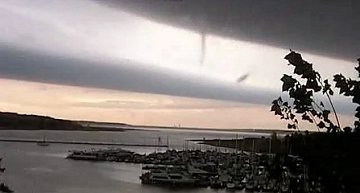
Movies: 5 MB mov, 5 MB gif, 13 MB gif.
Near-infrared images of Titan's surface and lower troposphere can be subtracted to reveal widespread cirrus-like clouds of frozen methane (lower images) and a large patch of liquid methane (dark area within box) interpreted as clouds and morning drizzle above the huge continent of Xanadu (outline). At left is a chart of Titan's aerosol haze versus altitude. Credit: Mate Adamkovics/UC Berkeley Future settlers take note: Galoshes and umbrellas are a must on Saturn's moon Titan, where mornings are eclipsed by dreary drizzles of methane.
Getting drenched would be the least of your worries, however, as Saturn's largest satellite plunges to a bone-chilling -297 degrees Fahrenheit (-183 degrees Celsius) at the surface and its swirling orange atmosphere is full of hydrocarbons, such as methane, which is natural gas—and no oxygen.
"Crude oil minus the sulfur is a decent estimate of what the haze is," said lead author of a new study of Titan's weather, Mate Adamkovics, an astronomer at the University of California, Berkeley. "Really we don't know for sure, but I would describe it as tiny particles of wax that are really, really cold, or waxy snowflakes."
Adamkovics added that while scientists are not sure how toxic the particles are, the lack of oxygen would be much more of a hazard.
Using near-infrared images from Hawaii's W. M. Keck Observatory and Chile's Very Large Telescope, the team of astronomers reveals a nearly global cloud cover at high elevations on Titan. They also found persistent morning drizzle made of methane over the western foothills of Xanadu, Titan's largest "continent."
Measuring about 3,200 miles (5,150 kilometers) across, Titan is larger than Mercury and Pluto and about 40 percent the diameter of Earth. It is the only moon in the solar system with a dense, planet-like atmosphere (10 times denser than Earth's).
As is the case on Earth, where features like lakes and mountains can morph and direct weather systems, Titan's terrain also could be a rain maker.
"Titan's topography could be causing this drizzle," said study team member Imke de Pater, an astronomy professor at UC Berkeley. "The rain could be caused by processes similar to those on Earth: Moisture laden clouds pushed upslope by winds condense to form a coastal rain."
Cloudy observations
The new findings, detailed in the Oct. 11 issue of Science Express, an online version of the journal Science, provide strong evidence supporting past cloud-cover observations and possible indicators of methane drizzle over parts of Titan.
In 2005, the Huygens probe that had been aboard NASA's Cassini spacecraft gathered data supporting the existence of frozen methane clouds at higher elevations and liquid methane clouds, with possible drizzle, lower in the atmosphere.
But the extent of such clouds was unclear. "A single weather station like Huygens cannot characterize the meteorology on a 'planet-wide' scale," said UC Berkeley astronomer Michael Wong, who was part of the recent study.
And until now, liquid rain was inferred from reports of lakes of liquid hydrocarbon, which scientists presumed were filled by methane precipitation.
Dreary Titan
Adamkovics and his team analyzed infrared measurements throughout Titan's atmosphere. By subtracting out the absorption and scattering due to aerosols low in the atmosphere as well as light from the surface, they were left with a signal that was due to actual droplets of liquid methane. Using a "radiative transfer model," the scientists distinguished between miniscule drops inside clouds and larger ones that form drizzle.
The results paint a dreary picture with a global cloud of frozen methane hovering at a height of about 16 to 22 miles (25 to 35 kilometers), liquid methane clouds below 12 miles (20 kilometers) and drizzling methane at lower elevations.
"We show that the solid cloud covers the globe and the drizzle happens predominantly in the morning," Adamkovics told SPACE.com.
The methane droplets inside Titan's clouds are estimated to be a thousand times larger than those in terrestrial clouds. Yet, both contain similar moisture contents, Adamkovics said. And if a cosmic cloud wringer were to empty out Titan's clouds, about six-tenths of an inch (1.5 centimeters) of water would blanket the moon's surface.
The drizzle or mist appears to dissipate after about 10:30 a.m. local Titan time, which is about three Earth days after sunrise. Titan takes nearly 16 Earth days to rotate once.
 A word pun on MySQL. Esquel is a town in Argentina. Here a dark sunset from under a tree. Orange and black.
Left: Sloan Digital Sky Survey (SDSS) image of the field where supernova 2005ap was found, showing four nearby galaxies (A, B, C, and D) in December 2004. Right: Hobby-Eberly Telescope (HET) image of the same field about 2.5 months later, showing supernova 2005ap. The supernova’s host galaxy is too distant to appear in either image. Credit: SDSS, R. Quimby/McDonald Obs./UT-Austin Robert Quimby has an unusual distinction among astronomers. The Caltech postdoctoral researcher has discovered the two brightest star explosions ever witnessed within months of each other.
Quimby's latest find is supernova 2005ap, which at its peak blazed 100 billion times brighter than the sun and was twice as luminous as the previous record holder, a supernova called 2006gy, which he also discovered.
Quimby actually discovered supernova 2005ap first, but confirmation of the blast's luminosity required follow-up observations that were only recently completed.
"There I was, finding my first supernova. I was just happy to get anything," said Quimby, who was previously at the University of Texas in Austin. "It turned out to be the most luminous supernova ever found."
The 2005ap supernova finding will be detailed in the Oct. 20 issue of The Astrophysical Journal Letters.
Like birds, not elephants
2005ap is a so-called Type II supernova, which scientists think typically occurs when the core of a massive star collapses under its own weight, triggering an explosion. However, 2005ap was 300 times brighter than average Type II explosions.
Quimby's other discovery, supernova 2006gy, emitted more than 50 billion suns' worth of light and took several weeks to dim. It was speculated the parent star of that supernova was a stellar behemoth with about 150 times the mass of the sun, and that the explosion represented a new mechanism involving an exotic antimatter engine that had been theorized but never observed.
Scientists think supernova 2005ap was more like typical supernovas because, like other Type II's, it brightened and dimmed over a matter of days.
"That means the physics [of 2005ap] has to be different somehow, but we haven't totally puzzled out the reason why," said J. Craig Wheeler, a member of the discovery team and Quimby's advisor at the University of Texas in Austin.
The team is not sure the exact size of 2005ap's parent star, but they estimate it must have been around 10 solar masses.
"We don't have a good number on [the mass]," Wheeler told SPACE.com. "But it wasn't a hundred solar masses like the other one or it would have behaved more sedately."
He added, "Elephants just move more sedately than birds."
Quimby discovered 2005ap by using telescopes at McDonald Observatory at the University of Texas in Austin and then followed up with observations with the Keck Telescope in Hawaii that were made by Greg Aldering of Lawrence Berkeley National Lab.
The combined observations were enough to determine that 2005ap was located 4.7 billion light-years away. The distance was crucial to determining the supernova's luminosity and establishing it as the brightest ever recorded.
Not luck
Quimby said it was hard work and not luck that enabled him to discover two bright supernovas in a row. "I'm searching a huge volume of space, comparable to all previous nearby supernova surveys combined," he said.
Quimby also looked for exploding stars in places other astronomers avoided, such as dwarf galaxies and galaxies with active black holes at their centers.
The new findings could force other supernova seekers to change their searching techniques. "There's no question that [Quimby's results] have gotten everybody's attention," Wheeler said.
The University of Michigan's Robotic Transient Search Experiment (ROTSE) project team is planning to shift gears and begin looking for supernovas in addition to its main target of gamma ray bursts, Wheeler said, and the Sloan Digital Sky Survey Supernova Search is also reconsidering its search filters in response to the new discoveries.
 A strange gaseous molecule has been discovered lurking in the atmospheres of both Mars and Venus, scientists announced today, adding that it could affect Venus's hyperactive greenhouse effect.
The molecule's signature was first noticed in Venus's atmosphere in April 2006, when the European Space Agency's Venus Express arrived at the planet and began to measure the composition of the atmosphere.
The Infrared Atmospheric Spectrometer instrument aboard the spacecraft watched the sun set behind the planet and measured the wavelengths of light absorbed by the planet's atmosphere. Because different gases absorb at different wavelengths, scientists can infer the composition of the atmosphere from the wavelengths that are strongly absorbed.
While observing Venus, scientists noted an unusual signature in the mid-infrared region of the spectrum that they couldn't identify.
"It was conspicuous and systematic, increasing with depth in the atmosphere during the occultation, so we knew it was real," said study leader Jean-Loup Bertaux of the Service d'aeronomie of France's National Center for Scientific Research (CNRS).
Later that year, NASA scientists observing Mars using telescopes in Hawaii notified Bertaux's team that they had found the same unusual signature.
Because the atmospheres of both Mars and Venus are composed of 95 percent carbon dioxide (as compared to Earth's atmosphere which has only 0.04 percent carbon dioxide and is composed primarily of nitrogen), the researchers thought the strange molecule could be an isotope of carbon dioxide. (Isotopes have the same number of protons, but a different number of neutrons than the main form of an element.)
This exotic form of carbon dioxide has one "normal" oxygen attached to its carbon atom, while the other attached oxygen atom has 10 neutrons, instead of the usual eight.
The differently-weighted oxygen atoms let the isotope absorb more energy than normal carbon dioxide molecules, which could mean that it contributes more to the greenhouse effect on stifling-hot Venus, the researchers said. (Because the isotope only accounts for about 1 percent of carbon dioxide molecules on Earth, its contribution to our greenhouse effect is likely very small.)
 The mummy of King Tutankhamun will soon go on display for the first time, exposing the bare face of the boy king, Egyptian officials have announced. The mummy will be removed from its sarcophagus and placed in a climate-controlled glass case in the antechamber of the pharaoh's tomb in Luxor in November (see Egypt map).
"I am taking [the mummy] out to show it to the public for the first time," said Zahi Hawass, secretary general of Egypt's Supreme Council of Antiquities.
The move is part of an effort to preserve the mummy, which has been in poor condition since it was first discovered, Hawass explained.
Archaeologist Howard Carter unearthed Tutankhamun's treasure-filled tomb in 1922, the first discovered with its riches so intact.
But Carter and his team partly destroyed the mummy in search of more treasures buried with the pharaoh, separating it into 18 sections, Hawass said.
Humidity and heat, much of it generated by the breath of the tomb's 5,000 daily visitors, have also taken a toll.
"Right now the mummy has no special protection from the humidity in the tomb," Hawass said. "The new case will be specially sealed to protect it from this sort of damage."
The pharaoh's remains will be partially rewrapped in linen with the face of the pharaoh left uncovered, according to Mansour Boraik, general supervisor of the Supreme Council of Antiquities in Luxor.
Officials hope the display will increase the number of visitors and generate profit for the conservation of other Egyptian antiquities.
"The 'golden boy' has magic and mystery that bring people from all over the world," Hawass said.
(Hawass is a National Geographic Society explorer-in-residence. National Geographic News is a division of the National Geographic Society.)
In 2005 Hawass opened the sarcophagus to perform a series of CT scans that allowed researchers to create a reproduction of the king's face.
(See photos of Tut's mummy and reconstructed face.)
"I was fascinated with his face," said Hawass, who noted the king's buck teeth are similar to those of the pharaoh's royal ancestors.
"Meeting King Tut face to face was very personal. … It was an important moment in my life."
Tutankhamun became pharaoh at the age of nine, ruling for only ten years in the 14th century B.C. before meeting an untimely death.
(Read: "King Tut Died From Broken Leg, Not Murder, Scientists Conclude" [December 1, 2006].)
Awakening the Curse
Exposing the mummy is likely to resurrect the myth of the pharaoh's curse, once believed to bring tragedy to those who disturb the tomb.
Most famously, Carter's sponsor, Lord Carnarvon, died shortly after entering the tomb from an infected mosquito bite.
Other tragedies were also blamed on the curse, and some experts have said ancient toxins lying in the tomb could have played a role.
"There is always mystery about King Tut, and it will never stop," Hawass said.
"Of course this will reawaken fears of the curse, as any new project involving the tomb or the mummy always does."
"I don't believe in the curse at all," he added. "But the gold, the intact tomb, the curse—all this history makes everybody fascinated by King Tut."
 The north of Mars is getting cold. It's winter and that brings temperatures as low as 140 C below zero. The most flamboyant sign of the season is a giant icy cloud hanging over the martian north pole--the North Polar Hood.
The electric blue color of the Hood is a sign that many ice crystals in the cloud are tiny--smaller than the wavelength of light. Sunlight scattered from sub-wavelength particles looks blue; local examples include cigarette smoke, noctilucent clouds and a New England sky.
Recent photos hint that the Hood is in motion possibly in response to warm dusty air wafting up from temperate latitudes.
False color Cassini image illustrating the jets of fine icy particles erupting from the south polar region of Enceladus. Please credit: Cassini Imaging Team and NASA/JPL/SSI Slushy geysers on Saturn's moon Enceladus erupt from fractures clustered around a hot spot at the satellite's south pole, scientists have now confirmed.
Using NASA's Cassini spacecraft, researchers recorded the location of jet events on Enceladus for two years. They found that the most prominent jets emanated from hot spots along four cracks, or "tiger stripes," on the moon's surface called Alexandria, Cairo, Baghdad and Damascus.
The monikers come from a naming convention created during the days of the Voyager spacecraft, which required features on Saturnian satellites be named after the myths and epics of the world. The fissures on Enceladus were named after cities in the Arabian story collection, "One Thousand and One Nights."
The discovery, detailed in the Oct. 11 issue of the journal Nature, is the first to directly link the tiger stripes and the jets.
"We suspected that the jets were coming from the fractures ... but this is now definitive proof," said study team member Carolyn Porco, leader of Cassini's imaging team at the Space Science Institute in Boulder, Colo.
The finding also provides new observational constraints for computer modelers attempting to simulate the geyser's underlying mechanisms, Porco said, and could help determine whether a vast liquid ocean—and possibly life—lies beneath Enceladus' crust.
An active moon
Geological activity on Enceladus was only confirmed about two years ago, when Cassini's infrared camera detected an anomalous hot spot on the moon's south pole and revealed that pale blue "veins" on the moon's surface were actually deep chasms spewing a mixture of liquid water, ice and organic compounds into space.
Scientists now think Enceladus' slushy ejecta are the source of Saturn's tenuous E-ring, and that other Saturnian moons passing through this ring are coated in the reflective substance, making them unusually bright.
Recently, scientists have theorized the geysers might be powered by the grinding of ice sheets against one another and the periodic opening and closing of gaps on the moon's surface.
Both mechanisms were thought to be driven by a process called tidal heating. Because Enceladus' path around Saturn is elliptical, it is pulled unevenly by the planet's gravity at different points along its orbit. This creates a bulge on the moon's surface that grows and shrinks depending on the moon's distance from Saturn.
The repetitive motion generates friction and heat, which scientists suspect drives the tiger stripes to open and close.
The new findings are generally consistent with the geyser mechanism models, except for one major discrepancy involving the tiger stripe Baghdad, said study team member Joseph Spitale, also of the Space Science Institute.
"They didn't predict almost any heating on [Baghdad], and we found our strongest sources there," Spitale told SPACE.com.
Future models will have to take Baghdad's activity into account, the researchers say.
The discrepancy "means that the people who are doing these kinds of models need to go and see if they can't tweak their parameters to try and match what we're observing," Porco said.
The go-to moon
Enceladus is only one of a handful of bodies in our solar system known to be geologically active, and, in Porco's opinion, is the go-to place to answer questions about astrobiology.
"Mars has been a candidate for a long time, but even the guys who study Mars will tell you—if they are being at all objective about this—that chances are there are no living organisms on Mars ... unless you go to the poles," she said.
Porco thinks Enceladus also has a leg up on Jupiter's satellite Europa, another leading contender in scientists' eyes as a life-harboring world, because many of the suspected requirements for life have already been confirmed on Enceladus.
"We've flown through the plumes. We've measured the presence of organics. We already know there's access heat" on Enceladus, Porco said. "The only outstanding question is, do these jets derive directly from liquid water or not?"
NASA's Chandra X-ray Observatory image shows the edge of RXJ1713.7-3946, a supernova remnant. On the right, X-ray hot spots are appearing and disappearing. The rapid rise and fall of the spots indicate that electrons are being accelerated to near-light speed in the presence of strong magnetic fields. Credit: CXC/Yasunobu Uchiyama/HESS/Nature Cosmic rays constantly bombard the Earth as tiny, extremely energetic particles traveling close to the speed of light, yet their origins have eluded scientists for nearly 100 years. A new study, however, brings the mystery a step closer to resolution.
Supernova remnants—the leftovers of massive stellar explosions—possess magnetic fields much stronger than previously thought, recent observations of pulsating X-ray hot spots reveal. Scientists said the discovery serves as some of the first direct evidence for a system powerful enough to accelerate particles into cosmic rays.
"Magnetic field strength lies at the heart of cosmic-ray acceleration theory," said Yasunobu Uchiyama, an astrophysicist with the Japan Aerospace Exploration Agency (JAXA).
Uchiyama and his colleagues' detail their findings in the Oct. 4 issue of the journal Nature.
Energetic mystery
Cosmic rays were first discovered in 1912, and since the 1960s scientists have suspected supernova remnants as their breeding grounds.
Such remnants travel through interstellar gas as they expand, producing high-speed shockwaves that can generate powerful magnetic fields. As protons, electrons and other charged particles from interstellar gas bounce around in the magnetic fields, they're accelerated to blinding speeds to create cosmic rays.
Cosmic ray factories in space work similar to Earth's particle accelerators, yet can pump particles with energies tens of thousands of times greater than the largest man-made machines.
Until Uchiyama and his team's discovery, however, magnetic fields strong enough to create cosmic rays had never been directly detected.
"Previous estimates of magnetic fields in supernova remnants were based on indirect arguments," Uchiyama said. "In our study, we determine the magnetic field in a direct manner."
X-ray hot spots
To make the discovery, Uchiyama and his team focused NASA's Chandra telescope on X-ray hot spots in a supernova remnant called RXJ1713.7-3946, located a few thousand light-years from Earth in the constellation Scorpius.
The hot spots brightened and faded in less than a year, a variability that is the hallmark of cosmic ray generation. Because the hot spots barely moved, the astrophysicists were also able to peg the speed of the supernova shockwave at 10 million mph (16 million kph).
The measurement allowed the team to gauge the strength of the remnant's particle-accelerating magnetic fields.
"This is an extremely important paper," said physicist Don Ellison of North Carolina State University, who was not involved in the study. "This is the first time such rapid X-ray variability has been seen in a supernova remnant."
Gemstones and dust might be created in the outer regions of supermassive black holes known as quasars as shown in this artist illustration. Credit: NASA/JPL-Caltech Like enormous jewel factories in the sky, the chaotic environments around some supermassive black holes crank out prodigious amounts of glass, rubies and sapphires, a new study finds.
The inevitable breakdown of these materials into simpler components could account for much of the space dust in the universe—dust that is recycled to make stars, planets, and life.
Traces of these minerals, as well as sand and marble, were recently found by scientists analyzing light from the region around a nearby supermassive black hole using NASA's Spitzer Space Telescope. The black hole was embedded in a quasar, a highly active and incredibly bright galaxy under construction.
"We were surprised to find what appears to be freshly made dust entrained in the winds that blow away from supermassive black holes," said study team member Ciska Markwick-Kemper of the University of Manchester in the U.K.
The finding, to be detailed in an upcoming issue of Astrophysical Journal, could also help solve the mystery of where dust used to build the first generation of stars in the universe came from.
The space dust in our corner of the universe is thought to have been created when ancient stars resembling massive versions of our sun exploded as supernovas at the ends of their lives. But when the universe was new, sun-like stars hadn't been around long enough to die and make dust. So where did the dust needed to make those stars come from?
One idea is that the dust came from quasars, which are supermassive black holes surrounded by dusty, doughnut-shaped clouds and lots of radiation. They are the most active, budding galaxies known, where gravity lures material in but the resulting pressure blows material away on a constant cosmic tug-of-war that results in high rates of star formation and the creation of new elements.
"Quasars are like the Cookie Monster," said study team member Sarah Gallagher of the University of California, Los Angeles. "They can consume less matter than they can spit out in the form of winds."
To test this theory, Gallagher and her team used Spitzer to investigate PG2112+059, a quasar located in the center of a galaxy about 8 billion light-years away. They found evidence of sand and minerals such as rubies that do not last long in the harsh environment of space, suggesting they were freshly made.
The researchers plan to look for evidence of dust around other quasars to strengthen their case. It's also possible, they say, that quasars were not the only source of dust in the early universe.
"Supernovas might have been more important for creating dust in some environments, while quasars were more important in others," Markwick-Kemper said.